
11/03/2018: HUNGARY – SEEMO CALLS FOR REVOKING OF SENTENCE AGAINST A JOURNALIST

11/03/2018: HUNGARY – SEEMO CALLS FOR REVOKING OF SENTENCE AGAINST A JOURNALIST

March 11, 2018 disabled comments

Vienna, 11/03/2018

The South East Europe Media Organisation (SEEMO) condemned the conviction of investigative journalist Gergely Nyilas on Tuesday, 6 March.

Following the surge of immigrant asylum seekers during the summer of 2015, Nyilas, who works for news site Index.hu and at the time reported about migration, entered Hungary in disguise, claiming he was an immigrant from Kyrgyzstan. After he revealed his true identity, he was accused of misleading authorities and forging public documents.

On Tuesday, a court in the city of Gyor (Győr) convicted the journalist and sentenced him to cover the costs of the lawsuit against him.

SEEMO harshly condemns the decision of the court against Gergely Nyilas and reminds authorities in Hungary that it was prohibited for journalists to enter refugee camps at the time, despite many requests from a majority of media outlets in Hungary. SEEMO supports Nyilas´ statement that he wanted to inform the public about the situation within the camps and the treatment of asylum seekers by authorities.

Prohibiting them from informing the public about relevant issues is detrimental to both media freedom and human rights.

SEEMO is a network of editors, media executives and leading journalists in South, East and Central Europe
08/03/2018: UKRAINE – SEEMO WELCOMES REVISION IN CASE OF A UKRAIAN JOURNALISTS

March 8, 2018 disabled comments

Vienna, 08/03/2018

The South East Europe Media Organisation (SEEMO) welcomed the decision of the Supreme Court in Ukraine, which decided to review the case of journalist Igor Efimov.

Efimov, who is a reporter for the newspaper Vechirni Cherkasy, was allegedly attacked by police members while reporting in Cherkasy in central Ukraine, despite having clearly and repeatedly identified himself as a journalist. He obtained serious injuries, including a brain concussion and shoulder dislocation. In February of this year, the Supreme Court noted that the previous decision to release a police officer suspected in the attack on Efimov was not legitimate nor justifiable, and the case must be reviewed by the appellate court again.

SEEMO supports this court decision.

SEEMO is a network of editors, media executives and leading journalists in South, East and Central Europe.

07/03/2018: HUNGARY – SEEMO CONCERNED REGARDING HUNGARIAN MEDIA SITUATION

March 7, 2018 disabled comments

Vienna, 07/03/2018

The South East Europe Media Organisation (SEEMO) expressed concern for the state of media in Hungary and its apparent worsening of free speech.

Since Viktor Orban (Viktor Orbán) reassumed the position of Prime Minister in 2010, SEEMO has registered many cases of media freedom violations and cases of unprofessional reporting in Hungary.

One news web-portal with alleged ties to the government published a story following the 1 October shooting of 58 people in Las Vegas with the headline “People on Twitter are wondering why George Soros sold his stocks before the Las Vegas massacre”.

Soros has also been the center plotline in countless other conspiracy theories published by Hungarian media, such as one in which he backed a campaign to overturn Brexit and undermine the Prime Minister of Great Britain Theresa May.

This organised media propaganda is systematically being fed to older, less educated generation of media consumers in Hungary, making it continuously more difficult for independent, critical media outlets to work and survive.

The consequences of not supporting professional and ethical journalistic work are already visible in Hungary through a diminishing number of media outlets and civil society organisations and the diminishing of their scope of activities.

SEEMO is a network of editors, media executives and leading journalists in South, East and Central Europe.

05/03/2018: CROATIA – FIRST INSTANCE VERDICT: 15 MONTHS IN PRISON FOR ATTACKING THE JOURNALIST

March 5, 2018 disabled comments

Vienna, 05/03/2018

After a last year attack on a journalist, according to a court decision in Croatia, Nenad Sajnovic (Nenad Šajnović) got 15 months of imprisonment and Ana Sajnovic (Ana Šajnović) was convicted to 6 months suspended sentence for threatening and to 30 days of imprisonment for disturbing law and order as well as to pay 1000 HRK for court expenses

On 16 September 2017 in Velki Pašijan a crew of Nova TV was shooting a story and was approached by Nenad Šajnović threatening to kill the crew members. He came to reporter Ema Branica and pushed her hard so she tumbled into a ditch. Then he attacked cameraman trying to break his camera. According to the police report Ana Šajnović (73) was supporting Šajnović in the attack by screaming and beating the TV crew.

SEEMO condemned the attack and called institutions to protect journalists.

SEEMO is a network of editors, media executives and leading journalists in South, East and Central Europe.

05/03/2018: UZBEKISTAN – RELEASE OF A JOURNALIST

March 5, 2018 disabled comments

Vienna, 05/03/2018

The South East Europe Media Organisation (SEEMO) was relieved to learn that Uzbek critical journalist Yusuf Rozimurodov has been released from prison in February.

Rozimurodov has spent 19 years behind bars on sedition charges, holding the longest-known prison term served by a journalist. He was released on 22 February from a penal colony in the town of Chirchik, near the capital Tashkent, and returned to his home village in the Qashqadaryo region.

Rozimurodov, today 54, was an active member of the opposition party Erk (Freedom) and wrote for the party newspaper. He was arrested in 1999, shortly after explosions in Tashkent which officials claimed were an attempt of assassination on the life of then-President Islam Karimov. The original sentence of 15 years found him guilty of plotting to kill the president and change the country´s constitutional order as well as creating a criminal group. The prison term was later prolonged.

Since Karimov´s death in 2016, his successor president Shavkat Mirziyoev has gradually agreed to release some political prisoners.

“We are relieved to learn that Yusuf Rozimurodov was finally set free, however the news cannot bring us any joy” SEEMO Secretary General Oliver Vujovic said. “After serving the longest sentence a journalist has had to face so far in Uzbekistan, he is released along with the unspoken realization that his imprisonment was absurd.” Vujovic added.

SEEMO is a network of editors, media executives and leading journalists in South, East and Central Europe.

World Press Freedom Day 2018 – by Eva Maria Grabmair, SEEMO Contributor

March 5, 2018 disabled comments

By Eva Maria Grabmair, SEEMO Contributor

You cannot not communicate (Quote: Paul Watzlawick)

People will always express their opinions and feelings to a higher or lesser degree, be it in their living rooms, back gardens, at the office, at schools, universities, on the city streets or taking a stroll in the countryside… And this is our right; it is exactly what we should be doing, not least in turbulent times such as these. And it is the media’s right and duty to report about what is happening, carefully checking and double-checking that what is to be released can be verified as being authentic. Then people will talk and write and blog even more about what is being reported, and – political, business and other decision-makers– will, as often as not, act upon it.

One essential aspect of new media is the speed at which this communication happens. New media holds a vast potential to really keep people up to date – or more precisely – up to the moment. There is, however, also a potential to underestimate the consequences of that speed and thus to overreact.

Nobody can verify in an instant whether the information can be proven. This is not supposed to mean that information provided by (new) media should be mistrusted; rather, that it should be checked and compared with the information other media sources – traditional and new – provide on the respective topics in order to be able to make informed decisions for oneself.

News is always close to hand – not least thanks to new media. With regard to World Press Freedom Day the release of news, observing good practice and with high quality. is and will always be based on thorough investigative research, unpopular though it may sometimes be. Opinions may differ. In our time; not only beauty but – unfortunately also truth – is in the eye of the beholder… it is to be hoped that people will not close their eyes when faced with verifiable facts presented by those who have dedicated themselves to representing media at its very best:

This also emphasized how valuable communication between representatives from different media is.

An exchange of ideas and experiences benefits all, for them to be able to work toward achieving the highest standards in journalism while making sure that media workers’ safety is ensured as best as circumstances allow. SEEMO has been working successfully for many years to achieve these goals and will continue to do so: This effort is definitely worthwhile!

This disclaimer informs readers / users of the web and information that the views, thoughts, and opinions expressed in an interview by the interview partner or in a statement by the author or in a blog belong solely to the interview partner / author of an article / blog and do not necessarily reflect the official policy or position of the South East Europe Media Organisation (SEEMO) Assumptions made within the blog are not reflective of the position of SEEMO. The visitors / users of the SEEMO webpage should take all steps necessary to ascertain that information you receive from SEEMO is correct. We ask every user to check references, double-check information from additional independent sources. SEEMO assumes no responsibility or liability for any errors or omissions, or for the results obtained from the use of information published on the SEEMO website / SEEMO partners website.

26/02/2018: SLOVAKIA – JOURNALIST JAN KUCIAK SHOT DEAD

February 26, 2018 disabled comments

Vienna, 26/02/2018

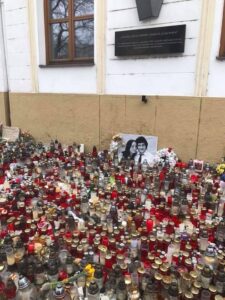
The South East Europe Media Organisation (SEEMO) is shocked to learn of the death of Jan Kuciak, a 27-year-old Slovakian reporter working for “Aktuality.sk” (publisher Axel Springer) and his partner Martina Kusnirova. The bodies were found on 25 February 2018 at their home in Velka Maca (Veľká Mača), in south-west Slovakia, some 60 km from the Slovak capital Bratislava. Slovakian police launched a murder probe.

Kuciak, born on 17 May 1990, worked on corruption cases, as also on allegations of tax evasion and connections between businessmen and top-level Slovak politicians. Kuciak had also been working on an investigation that delved into the infiltration into Slovakia of the Calabrian mafia. His last story on 9 February reported about a businessman known for his real estate deals.

“I am shocked by this sad news. This murder is a clear step against investigative journalism and press freedom. We call the authorities for a transperent investigation”, said SEEMO Secretary General Oliver Vujovic.

Kuciak is the first journalist ever to be killed in Slovakia.

SEEMO is a network of editors, media executives and leading journalists in South, East and Central Europe.

08/02/2018: CZECH REPUBLIC – CZECH JOURNALISTS MUST RECEIVE BETTER PROTECTION, SEEMO PLEAS TO AUTHORITIES

February 8, 2018 disabled comments

Vienna, 08/02/2018

The South East Europe Media Organisation (SEEMO) harshly condemned the attacks against media workers that occurred during the re-election celebrations of Czech president Milos Zeman.

On 27 January in Prague, supporters of Milos Zeman physically hassled journalists at the president´s re-election headquarters. While media reporters were trying to report from the scene, they were repeatedly pushed and hit; one reporter´s camera was thrown on the ground in an effort to prevent him from filming.

“We condemn the behavior of the supporters of re-elected Czech president towards media workers” Oliver Vujovic, SEEMO Secretary General stated.

SEEMO is a network of editors, media executives and leading journalists in South, East and Central Europe and its press freedom work is supported by the European Centre for Press and Media Freedom (ECPMF) project, as part of a grant by the European Commission

03/02/2018: TURKEY – SEEMO IS ASKING TURKISH INSTITUTIONS TO RELEASE TANER KILIC

February 3, 2018 disabled comments

Vienna, 03/02/2018

The South East Europe Media Organisation (SEEMO) was supprised to learn that Taner Kilic (Taner Kılıç), the Amnesty International’s Turkey Branch Executive Board Director, was released on 31 January from the prison in Izmir, only to be re-arrested before he was even discharged from prison and taken to Aliağa police station.

Kilic was initially detained in June 2017, suspected to have involvement with a “terrorist organisation Fetullah Gulen (Fethullah Gülen)”. Soon after, he was officially charged with membership in the organisation and remained in pre-trial detention.

After eight months in prison, the Istanbul 36th Heavy Penal Court ordered for him to be released on bail. However, as he was supposed to be discharged, a prosecutor appealed the decision and Kilic was detained once more. His next hearing is scheduled for June.

“We are distraught by news of Taner Kilic´s re-arrest and are deeply concerned for his wellbeing and rights” Oliver Vujovic, SEEMO Secretary General stated. “We call on authorities in Turkey to release him, along with all other journalists and human rights fighters held in prison ” Vujovic added.

SEEMO is a network of editors, media executives and leading journalists in South, East and Central Europe and its press freedom work is supported by the European Centre for Press and Media Freedom (ECPMF) project, as part of a grant by the European Commission.

01/02/2018: MALTA – SEEMO CONCERNED FOR FREEDOM AND SAFETY OF MALTESE MEDIA OUTLETS

February 1, 2018 disabled comments

Vienna, 01/02/2018

The South East Europe Media Organisation (SEEMO) expressed concern after it was revealed that the Maltese government is currently debating a new bill, which is set to repeal the country´s criminal libel law.

During 2017, several media outlets in the country became targets of the strategic lawsuits against public participation (SLAPP). These lawsuits aim to exhaust the media outlets through lengthy legal proceedings and high costs of legislative services. By depleting finances from media, individual companies and the government can censor and silence them more easily.

Investigative media project The Shift was threatened with a lawsuit of this sort after having published a letter they received from a company that manages Malta’s cash-for-citizenship scheme. The Shift’s co-founders Caroline Muscat and Jurgen Balzan published a message from a company, which demanded that the outlet remove an article revealing the company´s involvement in a recent diplomatic passport scandal. The company denied its attachment to the case and threated legal action in the UK and USA if the article was not removed.

According to Caroline Muscat, all SLAPPs aimed against outlets in Malta come from two companies.

SEEMO is a network of editors, media executives and leading journalists in South, East and Central Europe and its press freedom work is supported by the European Centre for Press and Media Freedom (ECPMF) project, as part of a grant by the European Commission.