9/6/2018 KOSOVO: THREATS AGAINST JOURNALIST

9/6/2018 KOSOVO: THREATS AGAINST JOURNALIST

June 9, 2018 disabled comments

Vienna, 9 June 2018

The South East Europe Media Organisation (SEEMO) is alarmed about threats that journalist Bujar Vitija, eceived by the state official. Vitija reported this case to the Kosovo police.
8/6/2018 TURKEY: COURT CASE OF ZAMAN

June 8, 2018 disabled comments

Vienna, 8 June 2018

The South East Europe Media Organisation in monitoring the court case agains several Zaman journalists in Turkey. The fifth hearing took place. The journalists face various coup or terror-related charges.

Next hearing should be in July 2018.

4/6/2018 CROATIA: THREATS BY MINISTER

June 4, 2018 disabled comments

Vienna, 4 June 2018

The South East Europe Media Organisation (SEEMO) strongly condemns the Minister of Veterans of Croatia Tomo Medved’s threats against journalist Vojislav Mazzocco, who works for Index.hr portal.

It is not acceptable to threaten a journalist who is doing his work professionally. Mazzocco was asking questions about ways the member of the Minister’s immediate family has been employed. In his article Mazzocco has given the possibility to the Minister to respond.

According to the journalist the Minister called him by phone on Sunday, 3 June 2018 at 14:46 and was threatening him. Mazzocoo reported those threats to the police in Zagreb

4/6/2018: RUSSIA: 12 YEARS IN JAIL FOR A JOURNALIST

June 4, 2018 disabled comments

Vienna, 4 June 2018

The South East Europe Media Organisation (SEEMO) condemns the decisions by a court in Russia against journalist Roman Sushechenko.

Sushechenko, working for the Ukranian news agency Ukrinform was arrested in September 2016 and now sentenced to 12 years in prison on espionage charges.


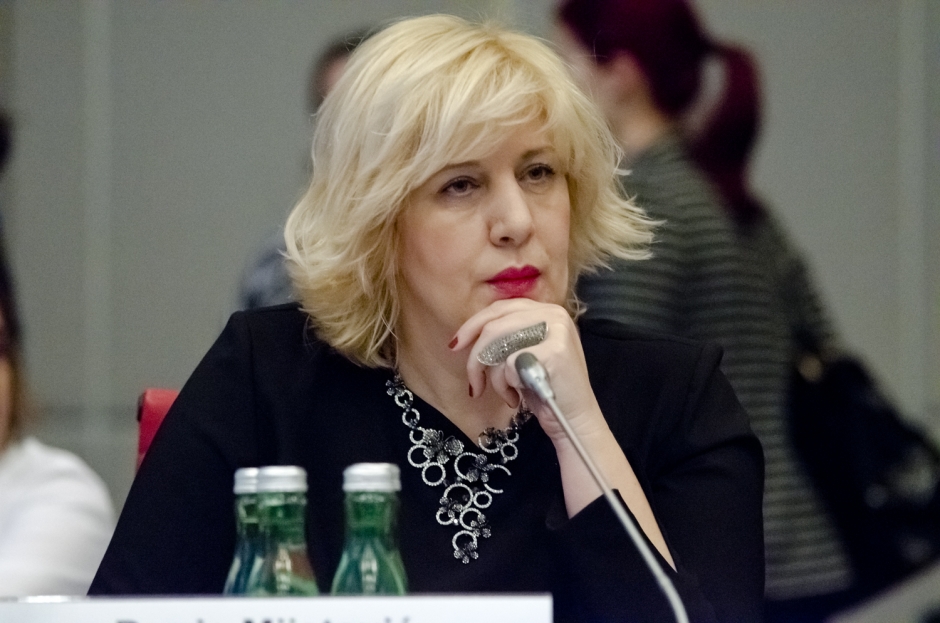
SEEMO Interview with Dunja Mijatović, OSCE (2015)

June 3, 2018 disabled comments

Dunja Mijatović is a media expert from Bosnia and Herzegovina. In 2010 she succeeded Miklós Haraszti as the OSCE Representative on Freedom of the Media (RfoM) and in March 2013 she was reappointed for a second three-year term.

SEEMO: What are the main press freedom problems today in OSCE member states?
I see two major trends challenging media freedom in the OSCE region; the increasing number of attacks on journalists and the attempts to filter and block access to the Internet.
Journalists’ safety must be ensured at all times, not just for the sake of justice also for the sake of democracy. And the fact is that we see more attacks on journalists today than we did five or ten years ago, this trend has to be reversed. And when I say attacks, I include a whole host of actions taken – just not physical assaults. Reporters/bloggers are jailed on dubious charges or held under house arrest simply for not toeing the government’s line.
The Internet is frequently under attack in parts of the OSCE region. There are definitely forces in motion that seeks to hinder the advancement of human rights online, making the Internet the new front line in the fight for freedom of expression and media freedom worldwide.
SEEMO: How you see especially the situation in two OSCE member countries: Turkey and Belarus?
In Turkey there are overarching issues with regard to free media and free speech; imprisonment of journalists and limitations on freedom of expression online.
Although the number of imprisoned journalists is significantly less today than it was only a few years ago, the much needed reform of the laws that allow for imprisonment for journalistic work – especially the Anti-Terror Law and certain provisions of the Criminal Code – has still not taken place.
Limitations of freed speech online continue and in 2014 the restrictive Internet Law, also known as Law No. 5651, was turned even more limiting. The estimated number of blocked websites is above 40,000 and we see accounts in social media platforms like Twitter and YouTube being silenced on a daily basis.
My Office also follow cases, in Turkey and elsewhere in the OSCE region, where individual female journalists are targeted for their work, this is an important issue that I plan to raise in more details in the coming months.
Although some positive steps have been taken in the past, free media are facing serious challenges in Belarus. The authorities need to show more political will to comply with international standards on free expression and free media. Areas of particular concern is the need for an immediate reform of the restrictive media law, changing the accreditation requirements for journalists, and intruding more effective ways to access information.
SEEMO: Do you have contacts with the officials in Ankara and if you look the situation in 2015 and some years ago – what is different in Turkey?
I have an ongoing dialogue with the authorities in Ankara and with the Permanent Mission of Turkey to the OSCE here in Vienna. Although we have different views on a number of issues with regard to freedom of expression and media freedom, we have a fruitful dialogue and a good co-operation. I trust that open communications about all issues, including sensitive ones, is the only mutually useful way forward.
SEEMO: What is the future of media in Europe after Charlie Hebdo attack?
The attack on the editorial office of Charlie Hebdo was an unprecedented attack on free speech and free media and I think we will be dealing with the fallouts from this horrific attack for quite some time.
The future of media depends on many different factors and it is not my role to try to predict it. Despite the emotional impact that the events in Paris may have had in journalists and media professionals around Europe and the rest of the world, I believe that the best reaction should be to continue exercising the right to freedom of expression without any form of constraint or self-censorship. On their side, governments should also facilitate the conditions for a pluralistic speech and media environment as well as adopt measures aimed at enriching discussions and influencing emotions in order to avoid all forms of aggression.
SEEMO: How can OSCE and your office of Freedom of Media help journalists who have problems, especially if journalists are arrested by a state authority?
My office is tasked to monitor media freedom developments in all 57 OSCE participating States. We assume an early-warning function on media freedom violations in the OSCE region and intervene on breaches of the OSCE commitments with regards to free media and free speech, like attacks and imprisonment of journalists.
In cases of imprisonment of journalists for what they say or write, my office raises these cases directly with the participating States. Voicing our concern about these cases, also with public statements, raises awareness and puts international pressure on the authorities to honor their international commitments on free speech and free media. This is one tool of many we use to help journalists deprived of their freedom.
SEEMO: Your comment to the Tomislav Kezarovski case?
I have been following this case very closely and I have raised it with the authorities on many occasions. Although I welcomed the latest decision to release him from prison, on probation, this does not negate the fact that the conviction sets a dangerous precedent for free media and investigative journalism, regardless of the fact that his sentence was reduced from 4.5 to 2 years in prison. It is high time for the authorities in the country to send a clear signal, ease the pressure on media, and respect free and critical voices.
SEEMO: How you see the media situation in Hungary in 2015.
Since the restructuring of the Hungarian media landscape in 2010, I have continuously voiced concerns about the restrictive elements of the media laws. Despite minor adjustments, the laws can still be used to restrict free expression and pluralistic discourse in the society.
My Office follows their implementation as we do with additional issues that have the potential to curb critical voices; including economic pressure by authorities on certain media outlets, libel suits initiated by public figures against critical journalists, or police raids against and investigations of NGOs using foreign funding.
SEEMO: How you see the role of SEEMO?
NGOs dealing with media freedom issues are crucial for the work of my office. SEEMO is a longstanding partner of the Office of the OSCE Representative on Freedom of the Media and it plays an important role for the development of free media in South Eastern Europe.

All information and reference, which are contained in this webpage, were compiled after best knowledge and examined with greatest possible care. This disclaimer informs readers / users of the web and information that the views, thoughts, and opinions expressed in an interview by the interview partner or in a statement by the author belong solely to the interview partner / author and do not necessarily reflect the official policy or position of the South East Europe Media Organisation (SEEMO) Assumptions made within an interview-analysis are not reflective of the position of SEEMO. The visitors / users of the SEEMO webpage should take all steps necessary to ascertain that information you receive from SEEMO is correct. We ask every user to check references, double-check information from additional independent sources. SEEMO assumes no responsibility or liability for any errors or omissions, or for the results obtained from the use of information published on the SEEMO website / SEEMO partners website.

23/5/2018 – RUSSIA: POLICE AGAINST VICBOR KORB

May 23, 2018 disabled comments

Vienna 23 May 2018

The South East Europe Media Organisation (SEEMO) condemns the use of counter-terrorism law against journalist Victor Korb, a journalist who works in Omsk.

On 18 May police came to his apartment and was investigated for publishing the text of a speech that an opposition activist gave during a trial.

21/5 / 2018 – CROATIA: THREATS IN VIROVITICA

May 21, 2018 disabled comments

Vienna, 21 May 2018

The South East Europe Media Organisation (SEEMO) strongly condemns threats against Ivan Žada and the webpage Virovitica.net.

The threats started after Virovitica.net published several articles related to the re-naming of streets in the town, including about one street that got the name of Mile Budak, who was one of the leading ideologists of the Croatian fascist Ustasa movement and Minister in the Croatian Independent State (NDH) in the second world war.

Ivan Žada, several times awarded journalist, was verbally attacked and threatened in social media.

19/5/2018 BELARUS: JOURNALIST ATTACKED

May 19, 2018 disabled comments

Vienna, 19 May 2018

The South East Europe Media Organisation condemns the today attack on journalist Siarhei Chaly in centre of Minsk. In the early hours of 19 May unknown persons attacked and beat Siarhei Chaly, author of the TUT.BY’s Economy for Dummies. patrols.

15/5/2018 RUSSIA: LEGAL CHANGES – NOT POSITIVE FOR RUSSIA

May 15, 2018 disabled comments

Vienna, 14 May 2018

The Vienna South East Europe Media Organisation (SEEMO) condemns the today introduction of an amendment to the Criminal Code of the Russian Federation, which penalizes “facilitation” of foreign sanctions toward public / private persons of the Russian Federation”.

The legal change criminalizes provision or recommendations and transfer of information that has led or might have led to the introduction of international sanctions. Violation shall be punishable by imprisonment of up to three years.

10/5/2018: BULGARIA: JOURNALIST ATTACKED

May 10, 2018 disabled comments

Vienna, 10 May 2018

The Vienna South East Europe Media Organisation (SEEMO) condemns the attack on Hristo Geshov, an investigative reporter based in the town of Cherven Bryag (Червен бряг) in the Pleven province in Bulgaria. Geshov was attacked and beaten today and was already the target of death threats in the past after reporting about alleged corruption in the town, including irregularities involving European Union funds,