09/11/2010: HUNGARY – HUNGARY CRITICIZED OVER MEDIA SECRECY LAW

09/11/2010: HUNGARY – HUNGARY CRITICIZED OVER MEDIA SECRECY LAW

November 19, 2020 disabled comments

Vienna, 09/11/2010

Hungary’s parliament last week passed another element of a controversial media reform package which will force journalists to identify their sources in stories involving national security and public safety. The law comes into effect on 1 January 2011.

If faced with judicial action, journalists would only be able to keep their source secret if such secrecy is ruled to be in the public interest. Also, when the information is deemed to contain state secrets or obtained illegally, the sources would have to be named.

IPI Press Freedom Manager Anthony Mills said: “An essential pillar of investigative journalism is the confidentiality of sources. Jeopardizing this will hamper the flow of information to journalists and will deprive citizens of their right to know about matters that may constitute an irritation to a government but lie squarely in the public interest. This latest move by Hungary’s parliament is another negative benchmark in the downward slide of Hungary’s press freedom environment.”

Dr. Ivan Lipovecz, an IPI board member and former editor-in-chief of Hungarian weekly newspaper HVG, said that the law would have a negative impact on the content carried by Hungarian media. “The law is against the normal democratic thinking of people and has just made public broadcasting dependent on the government,” he said.

The two-thirds majority enjoyed by the centre-right Fidesz party in Hungary’s parliament implies that it can pass almost any legislation and also alter the constitution. In recent months, the government has made many alterations to the media structure of Hungary, with several party members appointed to vital positions in the country’s media and programming.

The government has claimed these changes are necessary but IPI has warned that the moves are an attempt to “to exert control over public broadcasters.”

The South and East Europe Media Organisation (SEEMO) support the statements made.

****For further information, please contact:

Mirjana Milosevic
SEEMO Press Freedom Coordinator
South and East Europe Media Organisation (SEEMO)
E-mail: info@seemo.org
Web: www.seemo.org
10/11/2010: GREECE – ANOTHER ASSAULT ON GREEK JOURNALISM

November 19, 2020 disabled comments

Vienna, 10/11/2010

The South and East Europe Media Organisation (SEEMO), a network of editors, media executives and leading journalists in South East and Central Europe and an affiliate of the International Press Institute (IPI) is concerned at the recent assault on photo-reporters and foreign press journalists by security forces during the strikes in front of the Acropolis, in Athens, Greece.

According to information received by SEEMO, on 14 October 2010, in the morning, the police appeared to break the lockdown of the Acropolis by protesting short-term contract workers. While they began by telling journalists present to “go away and let us do our jobs” at first, after they got past the barrier, the riot police turned around and launched tear gas to disperse photo journalists and cameramen crowding in front of the barrier, trying to take pictures.

SEEMO Secretary General Oliver Vujovic said: “Once again, the deterioration of the media in Greece has yielded some truly appalling developments. In treating journalists like an obstacle to be shoved aside so “they can do their jobs”, Greek police appear to suggest that the right to information is subject to the whim of the powerful; it is very lucky that no one was hurt.”

Vujovic added: “In attacking journalists, the Greek police has exceeded its mandate. It is therefore to be hoped that the persons responsible for this will be punished in an exemplary fashion, thus enabling people to continue to believe that the role of the police is in the protection of citizens, not in the gagging of information workers.

This year has proven to be a very dark one for press freedom in Greece, as the number of attacks on journalists has increased quite dramatically. SEEMO would like to call on the authorities to make it clear that they consider the right of journalists to exercise their profession a cornerstone of the democratic system.”

15/11/2010: TURKEY – ON ‘STAND UP FOR JOURNALISM’ DAY, EUROPEAN FEDERATION OF JOURNALISTS THROWS WEIGHT BEHIND TURKISH MEDIA RIGHTS CAMPAIGN

November 19, 2020 disabled comments

Vienna, 15/11/2010

The Steering Committee of the Brussels-based European Federation of Journalists (EFJ) on 5 November 2010, lent its full support to a campaign by the Turkish Freedom for Journalists Platform, which seeks the release of all journalists currently imprisoned in Turkey.

EFJ representatives, along with their colleagues from the National Union of Journalists (NUJ) from the UK and Ireland and Belgium’s General Association for Professional Journalists (AGJPB), demonstrated in front of the Turkish embassy in Brussels, to mark the organisation’s fifth annual “Stand Up for Journalism Day”.

An EFJ letter to Turkey’s Permanent Representative to the EU, at the Turkish embassy in Brussels, Selim Kuneralp, noted that in Turkey journalists’ “fundamental rights to freedom of expression are violated on a daily basis.”

Meanwhile, in the Turkish capital Ankara, members of the Freedom for Journalists Platform which includes the International Press Institute’s Turkish National Committee – gathered opposite the offices of Turkish Prime Minister Recep Tayyip Erdogan and read out a press release.

The press release entitled “We Stand Up for Freedom for the Journalists” noted that as of 30 September 2010, there were 50 press workers in Turkish prisons; six of them have been sentenced.

It added that the rising number of imprisoned journalists and the thousands of cases brought against reporters were made possible by existing articles in the Turkish Penal Code and under Anti-Terror Laws – which restrict press freedom

In addition to the 50 journalists in prison, 25 media workers have been released after being detained, but the cases against them continue, and the authorities are demanding further imprisonment.

In the case of another 29 journalists, the exact terms of ‘punishment’ have not yet been set because their cases are under appeal, or have been postponed for as long as five years.

This means that more than 100 Turkish journalists face threat of imprisonment in the near future.

Most of the cases against the journalists, the press release noted, are grounded on Article 285 of the Turkish Penal Code relating to the alleged “Breach of Secrecy,” on Article 288 relating to the alleged “Influencing of a Fair Trial”, and on Anti Terror Law Article 7 relating to the “Propanda of a Terrorist Organization.”

The press release added that in this context, and combined with a gradual increase in the number of investigations, court cases, physical assaults, and threats against journalists, as well as concerns over the ongoing cases related to the murder of journalists Hrant Dink and Cihan Hayirsever, and the banning and confiscating of publications, there are fears that the crackdown on the media could intensify further.

It is not possible to speak of press freedom or freedom of expression in Turkey, according to the Turkish Freedom for Journalists Platform.

“Journalists, who are the eyes and ears of the public should be protected within the framework of professional principles and should have the right to report and communicate freely, and to inform the public,” their press release said. “Articles instructing journalists ‘not to write, speak, critize or comment’ constitute a Damocles Sword … .”

In the press release, the Freedom for Journalists Platform unequivocally demanded that the Turkish government release all journalists in Turkish prisons and that the government and parliament make radical amendments to Turkey’s current legislation, to steer Turkey away from a dangerous course and to prevent it from “breaking off” from the world.

All of Turkey’s press organizations issued press releases on 5 November 2010, to show solidarity with their Turkish colleagues.

Meanwhile, press organizations in Europe are submitting a letter to the Turkish embassies in their countries expressing their concerns over the current press freedom conditions in Turkey.

The Freedom for Journalists Platform thanked its European colleagues, notably EFJ, for their solidarity.

IPI Board Member Ferai Tinc, who is also the president of IPI’s Turkish National Committee, said: “This is the first time in our country that 23 journalists’ associations have come together for freedom of the press in Turkey. We stated our demands and asked for for the clearing out of all articles threatening press freedom, notably from the Constitution, and also from the Turkish Penal Code, and Anti-Terror Law. We believe that this international solidarity will contribute to freedom of the press in Turkey. The Freedom for Journalists Platform of which IPI Turkey is a member – will continue its struggle until our demands are fulfilled.”

IPI Press Freedom Manager Anthony Mills said: “It is great to see the European Federation of Journalists throw its weight behind Turkey’s Freedom for Journalists Platform in its efforts to seek the release of the 50 journalists currently imprisoned in Turkey. It is unacceptable that journalists be tried and imprisoned because of their work. As we have noted before, it is essential that Turkey bring its treatment of journalists into line with universal human rights standards.”

Oliver Vujovic, Secretary General of SEEMO, said, “It is encouraging to note the solidarity in the media community in Turkey and as a whole, for the cause of these imprisoned journalists. We call on the Turkish government to heed the demands of the journalists associations, and to ensure that all undue restrictions on journalists are removed.”

The Freedom for Journalists Platform includes:

The Turkish Journalists’ Association, The Turkish Journalists’ Trade Union, The Turkish Journalists’ Federation, the Press Council, the Press Institute (IPI Turkey), the Contemporary Journalists’ Organisation, the Diplomacy Reporters’ Ass., the Economy Reporters’ Ass., the Ankara Journalists’ Ass., the Newspaper Owners’ Ass., Haber-Sen, the Izmir Journalists’ Ass., the Culture, Tourism and Environment Journalists’ Ass., the Media Ethics Ass., the Professional Reporters’ and Cameramens’ Ass., the Parliament Reporters’ Ass., the Turkish Photo Reporters Ass., Turkish Sports Reporters’ Ass., the AEJ Turkish representative, the Economy Newspapers Ass., the Environment and Training Reporters’ Ass., the Press Foundation of Journalists’ Ass., and the Ugur Mumcu Investigative Journalism Foundation.

The South and East Europe Media Organisation (SEEMO) supports the statements made.


****For further information, please contact:

Mirjana Milosevic
SEEMO Press Freedom Coordinator
South and East Europe Media Organisation (SEEMO)
E-mail: info@seemo.org
Web: www.seemo.org
17/11/2010: KOSOVO – TV KLAN KOSOVA HOST THREATENED BY FORMER MEMBER OF PARLIAMENT

November 19, 2020 disabled comments

Vienna, 17/11/2010

The South and East Europe Media Organisation (SEEMO), a network of editors, media executives and leading journalists from South and East Europe and an affiliate of the International Press Institute (IPI), strongly condemns the alleged threats received by TV Klan Kosova moderator Baton Haxhiu from former Member of Parliament (MP) Gani Geci in Kosovo.

According to information received by SEEMO, on 9 November 2010 the show “Debate Zone” on TV Klan Kosova was cancelled due to the alleged threats made by Geci, a former MP of the Democratic League of Dardania (LDD).

“The show was interrupted due to the assault from Geci, who violently prevented the host, Baton Haxhiu, from starting the show”TV Klan Kosova announced on the television and on their website. In a subsequent press release, Geci alleged that his actions were due to Haxhiu’s attempt to exclude him from the show. TV Klan Kosova confirmed said intent. Geci left the premises shortly before the arrival of the police, who were reportedly summoned by the station.

“SEEMO strongly condemns this case and considers such actions as interference and obstruction of the media, made worse by the fact that the perpetrator is a former MP” said SEEMO Secretary General Oliver Vujovic.

“Any such actions, especially violent ones, create a difficult environment for journalists; no excuse can wash away the stain of such deeds. We call for the LDD and authorities in Pristina to distance themselves from such acts.”

Roberto Antonione, Secretary General, Central European Initiative (2020)

October 18, 2020 disabled comments

The Central European Initiative (CEI) is a regional intergovernmental forum with one central mission: working towards European integration and sustainable development through regional cooperation among its 17 Member States.It supports a united Europe with shared values embracing all countries, regions, peoples and citizens; and fosters the strengthening of capacities of its Member States towards good governance, rule of law and sustainable economic development for stability, social cohesion, environmental sustainability, security and prosperity.

The CEIoperatesas a platform for political dialogue through inter-governmental, parliamentary and economic dimensions, but also creates new opportunities for cooperation thanks to the transfer of innovative solutions and best practices and by building synergies and partnerships.

Regional cooperation for a Europe without borders remains our long-term commitment.

SEEMO is a long-standing partner of the CEI. Both organisations are regional and have a thorough knowledge of local issues. Therefore, their activities complement each other. SEEMO defends media freedom and promotes quality journalism, which are essential instruments of democracy. The CEI considers the promotion of freedom of expression in the media one of the key elements of its overall strategy.

The CEI cooperates with SEEMO in the framework of various projects and activities. In particular, the CEI is one of the main partners of the South East Europe Media Forum (SEEMF), an event offering a valuable platform for promoting professional contacts and discussions throughout the region in order to improve the quality of the media as pillars of democratic development. 


Our fruitful cooperation has also led to the creation of the CEI SEEMO Award for Outstanding Merits in Investigative Journalism. Recipients are journalists who excel in objective reporting despite the difficult conditions under which they often have to operate. Over the years, many talented and often young journalists from the CEI region have received this recognition which has actually contributed to supporting and encouraging their work.

We are proud to be a partner of SEEMO for its major commitment to protecting and enhancing press freedom.

Roberto Antonione
Secretary General
Central European Initiative (CEI)

Interview with SEEMO member Besar Likmeta (October 2020)

October 16, 2020 disabled comments

Tell us a little about yourself, your family, including how you got started as a journalist?
I am originally from the seaside port city of Durres in Western Albania, where I spent my childhood playing through its Roman ruins, hiking the hills full olive groves and going to the beach. I got started in journalism at the Florida Times Union – the metro newspaper of city of Jacksonville, Florida, while I was in college.

Your professional work…
After I came back to Albania, I have worked as a correspondent for Balkan Insight, BIRN’s flagship regional publication and contributed bylines to Foreign Policy, Washington Post, Christian Science Monitor, Businessweek, Transitions Online, Global Post, the Sunday Telegraph and many other news outlets.

You work now for years for BIRN. Can you tell us a little more about your work, please.
I have been the Albania editor for BIRN for more than a decade and has been one of the most gratifying experiences of my professional life, working with a wonderful pool of editors and journalists, helping to establish a tradition of quality investigative reporting in Albania.

Is it hard to be an investigative journalist in Albania?
It’s hard to be an investigative journalist everywhere. There are places that it is easier than in Albania and places where it’s much harder than in Albania. The thing is that the truth has enemies everywhere and Albania makes no exception.
  
Attacks on investigative journalists are very often. You have also been attacked. Can you tell us more about it.
The public often sees attacks journalist suffer as a badge of honour, as a sort of baptism by fire that shows the length of mudded waters stirred by our investigations, but this can’t be further from the truth. There is no need for journalists to be attacked – both physically and verbally, for their work to matter and for society to notice and take up note.
  
What was your biggest challenge in your work?
The biggest challenge of my work is the increasing threat of government regulation of online media in Albania.
  
How you see the media situation in Albania today?
In recent years the media situation in Albania has deteriorated, due to the political and economic interests of media owners that skew the editorial line, physical attacks against journalists that go unpunished, poor job security and a crises that has being brewing for years in a crowded market – made worst by COVID-19.

How hard it was to stay always professional as journalists?
Depends how deep you conviction goes that professional journalism is essential to a democratic society. Certainly all journalists make mistakes, but we learn from them and through time it’s easier to be professional.

Has Covid19 influence on the media in Albania?
The coronavirus has cut advertising revenue and in some outlets journalists were forced to accept painful salary cuts. The journalists as frontline workers have faced the risk of infections and the psychological trauma of covering the effects of the pandemic. Access to information has been restricted and journalists have struggled to gate face time with human sources.

How important is the work of SEEMO for you?
SEEMO is a partner organization that helps raise concern in early critical stages when journalists are attacked and threatened – a time they need support the most.

Do we have solidarity between journalists in Albania?
We have solidarity among journalists but not always solidarity from media organizations toward journalists.

Please walk us through a typical workday. How do you manage your time today?
A typical work day starts with reading the media headlines over a cup of coffee and ends up late in the evening editing the day’s stories that reporters bring in the office.

Finally, as press freedom, human rights and democracy are very important in your life, can you give please some advice for younger journalists?
The best formula for young journalists is to be honest and truthful to their audience and readers. If you can’t respect them and their right to access factual, balanced and objective information, they should consider a switch to PR.

Interview with SEEMO member: Nelly Katsama (October 2020)

October 4, 2020 disabled comments

Tell us a little about yourself, your family, including how you got started as a journalist?

First of all I would like to thank you for the opportunity to talk about journalism in Greece. Not so much for my case as I do not like to talk about myself, but obviously from my personal point of view, conclusions are drawn about who I am and how I walk in life and profession.I was born half a century ago plus 5 years, and all I remember was looking for all the answers, to all the questions.

What I was always looking for was the truth behind the events, big or small, that determined my family’s life, the resistance against the German occupation and the award of poverty and marginalization as a reward from the State. In the division of people into mortals and others. To the poor and the rich. Nobles and plebeians.

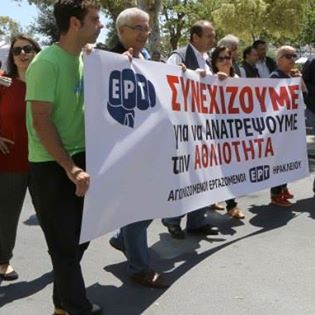
So, the only profession that could give content to these searches, I think, was journalism. This was the only one I chose and as a reward I received the award from acquaintances and friends that I made the profession of journalist my life. So I started as a teenager, as a newspaper editor, and later, as a reporter before moving to the Hellenic Broadcasting Corporation ERT.

Your professional work…

So my professional career of about 29 years, concerned free reporting and research, interviews, radio programs, television documentaries, responses to the main program of ERT where I became editor-in-chief, and radio producer.

However, at the same time I worked in the private sector in newspaper and television, as a columnist, main presenter of news and news programm.I left the private sector when ERT asked me for exclusivity in employment.

ERT, the public broadcaster in Greece is part of your life. Can you tell us a little more about your work in ERT.

ERT is my whole life, literally. I was young when I got a job right after the military administration left its second channel, which became ERT2 from the Armed Forces Service, and I left on the first day of its reopening and after two years of blackness with its closure by the Samaras Government. Therefore, I belong to that group, which created and set up free, pluralistic information and politically correct speech after the military on 1983. Consider that every commander of a military unit was the director of what we now call ERT2 and half of the regional radio stations, including the radio station in my city, where I worked with various forms of work, which I described above.

What is the difference between journalism when you started and today?

The transition was not easy. There were people, workers who had learned to obey military orders, and under them to produce a program. But, with the guidance of inspired people, the team that took over after demilitarization and included me, we started from the beginning, what we call and real information. It was easier to work impartially, objectively, respectfully following the rules of ethics in the periphery, than it was in the center. The center was and always is closer to the government, and in Greece, the government aw any other Power, has always seen the press as a means of propaganda and not objective and pluralistic information of the citizen.

What was your biggest challenge in your work?

The changes in the field of information and journalism, changed from the invasion of a new type of entrepreneurs in the field of Press. Entrepreneurs who saw the power of the press as a means and tool of power but also the imposition of political and economic power. And obviously they also chose employees willing to serve them. So the journalists instead of servants of information, they became image makers and considered themselves as the fourth power in the country, and a large part of them quickly slipped into what tends to dominate if it has not already dominated, whoever pays controls citizen information.

Only this is not information, it is propaganda, sometimes highly paid and sometimes very cheap.Apparently, the ten-year economic crisis of the country, the changes and the new media, which brought cheap, unpaid and uninsured potential, also helped in this. And as I mentioned before, whoever pays, also checks the information. It is therefore not surprising that Greece has no confidence in its information.

The data of the latest report of the Reuters Institute Digital News show that in our country only 28% of the respondents trust the news! The preference for information has shifted from traditional media to social media, such as Facebook, which is exacerbating media penetration.

What is the biggest challenge in my job? To remain the one I started. Not out of romance, but out of position and values. Even if the road is lonely. Even if I look foreign to the situation situation that has been formed and consolidated in the sector..

How you see the media situation in Greece today?

The constant confirmation of the low credibility of the Greek media in recent years constantly makes the landscape black and gloomy. Note that the current government pays the media to reproduce its propaganda as information, while the previous government, apart from the party newspaper and party radio, had a war against all other media. It is all a matter of money.Whoever pays has the appropriate treatment and promotion. It is no coincidence that during the pandemic, even yesterday in Parliament, the debate in the public sphere is how many millions the Government has given to the media to “play” how effective and excellent its policy is.

Attacks on journalists and media companies are a problem in Greece. How to change it and stop the attacks?

Whoever is not “yours” is an opponent. Anyone who does not propagate “my political truth”, anyone who dares to investigate scandals and corruption, is eradicated, and under attack and threat. So the question is who dares ?? Few. How will this change ?? How could we go back to point 0? I thought the crisis would be an opportunity, and a bet to restart. For a return to principles and values. Unfortunately, poverty and unemployment, especially their fear, do not help on the contrary, they exacerbate the problem.

And the human rights situation in your country?

In Greece, with the economic crisis that has recovered with the coronavirus pandemic, the acute refugee issue for the past five years, I am afraid that human rights are constantly falling apart and is under persecution.

It is also worrying that extreme racist and neo-Nazi voices are gaining strength in the country.

How hard it was to stay always professional as journalists?

Personally, it is never a problem for me to remain a professional journalist. Not without cost. At work, and in my life. Even in my health. I have been suffering from multiple sclerosis for the last few years, and this has reduced my professional activity to a minimum with a disability pension. Therefore it is not an exaggeration. Being a professional journalist has implications.

You were very active in the trade union, in the Panhellenic Federation of Journalists’ Union, but also in international in IFJ and EFJ. Can you tell us a little more about this work.

Trade unionism is an important chapter in my life. It was my honor to represent my organization in the Federation and the Federation internationally. It all started when the Federation on 1998 for my contribution to the objective and valid information of the public opinion and for a dynamic journalistic presence that paved the way for the equal participation of women in the evolution of the Greek press.

For trade union consistency, competitive spirit and solidarity, I have been honored on 2018 by the Union of Authors, of which I am a member. Between us, however, I am afraid looking at the state of information in Greece that I have failed. For 20 years, with few exceptions at the level of Associations, we have neither Collective Bargaining Agreements, nor a minimum guaranteed income, nor adequate public insurance. Greece remains a closed club, which hides the big picture. I ended up with all this, remaining a simple member of my Union, when the Federation, following the demands of the extreme voices that now govern it, succeeded in not holding the annual meeting of the EFJ because, the country then called FYROM would attend the conference as Macedonia with two representatives. That’s it. Politics and not journalism. Party diplomacy and not the search for solutions to the aggravated problems of the industry. The conference was held in Bucharest. I left the Federation as it made no sense to go to war with people for whom trade unionism was another level of power. After all in my country, where the Writers’ Unions ask the Government to create jobs, ie press offices in Municipalities, regions, Ministries, in order to hire journalists, to do propaganda work, what point of view do you want me to have?

Has Covid19 influence on the media in Greece?

Is it possible not to affect them ?? Evil is magnifying. Elastic forms of work, distance work, unemployment and Government resources to those who remain to produce propaganda “the Greek Government does everything perfectly, better than all countries” and to hide that the pandemic became an opportunity for enrichment and squandering of public money for some while impoverishing the majority of the Greek people.

How important is the work of SEEMO as a press freedom organisation? SEEMO organised some years ago a mission to Greece, can a mission help to improve journalism and solve some problems?

The mission that took place in Greece was very important. It helped to change a law that we called a tyrant for many years. And this is not small at all. Fearing persecution, journalists were considered undercover for many years. It does not matter if this perception is entrenched in some. The law, however, has changed.I wish there were other missions.

My colleagues in the North Aegean would need your support, as they are confronted daily with the darkest instincts of the far right in their region, reporting on immigrants.

Do we have solidarity between journalists in Greece?

In general, yes, we have solidarity if it is often exhausted in issuing a statement in order to denounce an attack, whatever its form, against them. Sometimes, the one who seeks solidarity also writes the statement of support.


You live in Heraklion. What is the difference between journalism in a smaller town and to be a journalist in a capital like Athens.

There are no big differences now between the center and the periphery of the country. Perhaps in smaller societies, control is greater than in society itself. The problems are the same, as the crisis is widespread in the country.

Please walk us through a typical workday. How do you manage your time today?

As I said before, due to my health problem I have limited my professional activity. However, I always work on archives, mainly history, as a consultant on a TV show for autobiographies on public television all the time, so I read, read, research, keep up to date. Mostly my work is done from home with a very flexible schedule. But no discounts on the basics.

Finally, as press freedom, human rights and democracy are very important in your life, can you give please some advice for younger journalists?

Tip …. As difficult as it is, the profession of journalist is an exciting adventure, anti-authoritarian, therefore it is a continuous path to freedom. And freedom is the supreme good of man. Therefore it is an honor for each of us to serve it every day.

Interview with SEEMO member Orhan Galjus (September 2020)

September 30, 2020 disabled comments

Tell us a little about yourself, your family, including how you got started as a journalist?

I’m a “language man”, I’m multinational man. I’m multigenerational, I’m G, and those with unmatured brain call me Gypsi, but originally my interpretation of that “G” – means Galjus, it is my proud family name which is very rare among the Rromani communities.

Because of the fascist, who knew that Rroma have often such family name my grandfather, who was attacked by Italian fascist, gendarme in our Rromani street, he decides to change the family name from Kalo to Galjus.
“Kalo” (in Rromani and in Indian languages “kala” means “black”. “Kalo” families the most widespread families, (somewhere is written like Callo, Kahlo).

Orhan Galjus

What is the difference between journalism when you started and today?

It is big difference. The global development of the World, the notion of democracy and the change which occurred in 1970s, 1980s (in this period I started to be journalist) then1990s, 2010s the new media technologies, political economy of the Europe and the World, the internet, new age social media all that contributed to metamorphoses in and within journalism.

Today much busier and much faster! But, in 1980s, I had enough TIME to drink coffee with Belgrade opinion maker on 23rd floor of Beogradjanke, famous, late, Dusan Radovic. As well as it was a pleasure to discuss with my colleagues about the TRUTH and BEATY in journalism while being in Prishtine or Novi Sad.

The journalism has changed; the “mind set” of the media is influenced by cameleonistic feature by the ownership issues where the journalism has nor “j” from… or the unfair games of the rich “donors”.

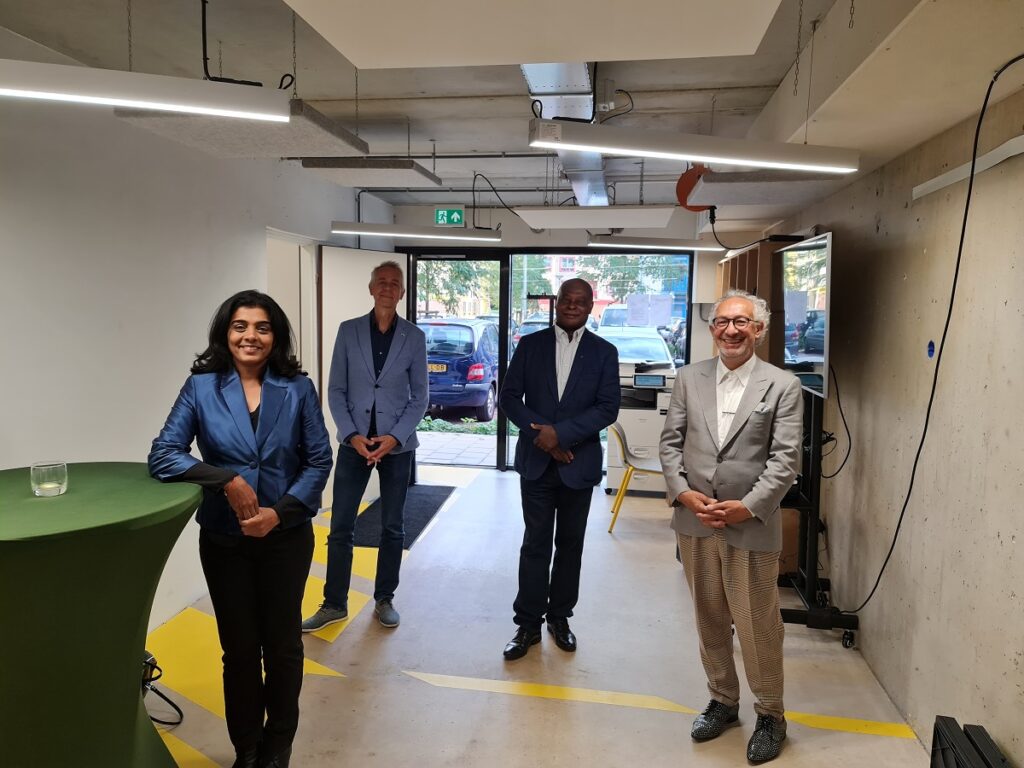
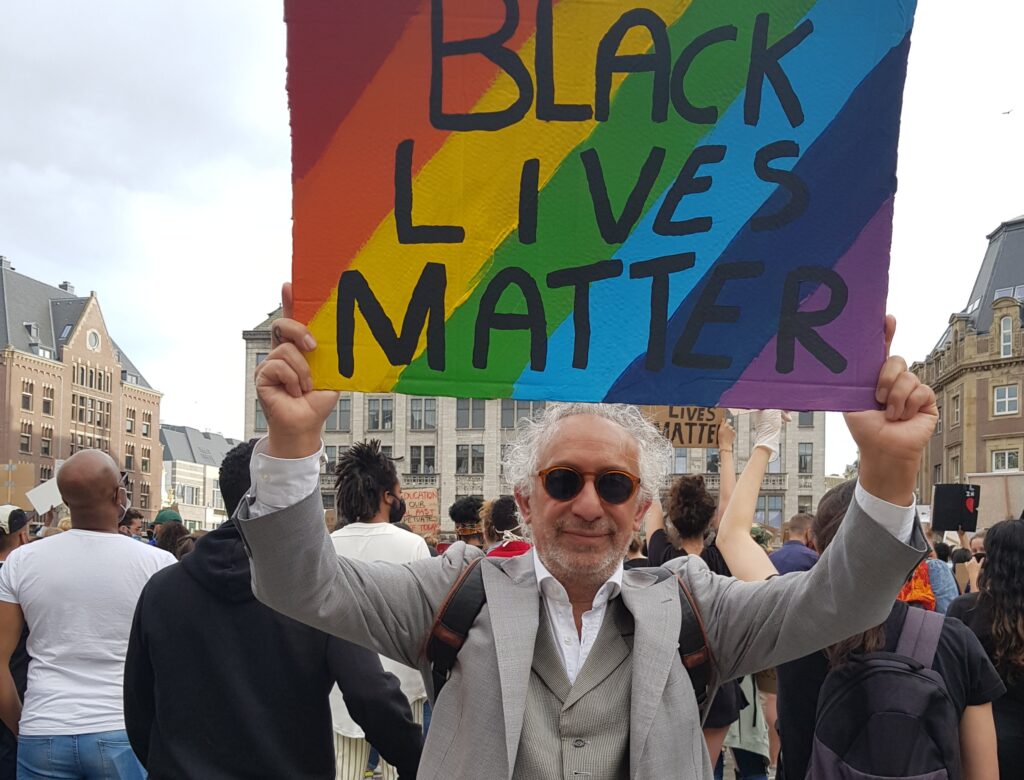
Orhan Galjus with Chair of Amsterdam South East District

You lived in many countries. What is your homeland?

Right, my professional life made such nice, beautiful line, life is as the art itself. My homeland is where is my life. But, answering sincerely I have now two homelands, my native town Prizren in Kosovo, and the Amsterdam, city of my life, The Netherlands is as my homeland too. Half of my life I spent as Dutch national.

Also, I have, I’m emotionally and genetically related to my country (homeland) of my origin, to India. I have been few times in India and there I breath as at home.

Many experts are saying that you are the leading journalist and expert between Roma journalists not only in the SEEMO region, but in Europe. What means this for you?

It is first of all responsibility, I really find that that we journalist we are skilled to speak out to talk and to bring THE TRUTH. Any other deviation is not acceptable for me. Some time when I’m demanding to get what is the reality, people think I’m radical rude. No place for the lies. Me and my fellows Rromani people we are tight with my skill in journalism. No doubts the way I can present the biggest European minority would not bring any other profit then being militant for the equality and truth. To hear that that being leading journalist and knowledgeable (NOT EXPERT!) serves me to be unstoppable for the rights of the and not only Rromani people.

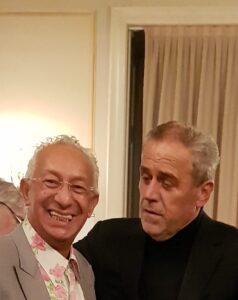
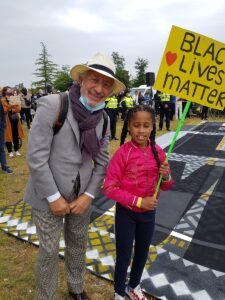
Orhan Galjus with the Mayor of Zagreb

Probably it was not always easy for you to work. Did you receive threats?

Yes … that made me to do more!

You have been also active in activities that are not connected to journalism, but more in fight for human rights of the Roma population in Europe. Can you tell us please a little more about this side of your life?

I have been surprised in my life to see something so important that I didn’t see it in my childhood:

I was refused to be registered as Rome in gymnasium, then I tried as “Serbian”, “Turkish” (my name is pure Turkish) and in the end I declare that I’m Albanian! So, I succeed! Finally I have been registered in my dream school!

From 1990 I have been participating as a member of important associations, NGOs, international organisations. Being in some leading positions, I realized why we Rroma still suffer after Second WW. It was important to talk to various people, to my neighbours, to politicians to build a diplomacy without being diplomat. I do remember my talks to Simon Wiesenthal, to Otto van Habsburg, to USA Ambassadors of Visegrad, to Jacque Delor, to Council of Europe leaders, being on same table with Condy- Condoleezza Rice, then with Sushmaji Swaraj, Hannes Swoboda, long talks with Juan de Dios Ramirez Heredia, Behgjet Pacolli, etc. And this has strengthened my exclusively actions to bring the Rromani “agenda” in the front of the Europeans. Was unbelievable to feel on “my skin”, discrimination, racism, anti-Rromani sentiments so there was no time to think twice. Still Im not satisfied: I must talk back to Commissionaires, Vjera Jurova, Frans Timmermans, we have unfinished talks. And might happen soon.

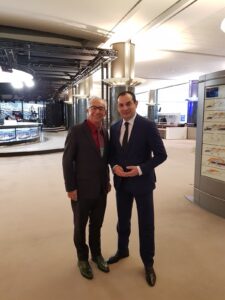
Orhan Galjus with MEP Peter Polak at the European Parliament in Brussels

You worked also for the Open Society office in Budapest. How important was this work for you?

Very important part in my life to learn the mechanism of a donor(s), of philanthropist. Also, to one who is part of such NGO the doors are open.

What was your biggest challenge in your work?

Ethics in journalism, independent financial sources to continue on with development of media.

How you see the situation with Roma media today in Europe?

The situation of the Rromani media is not good! I feel defeated, we didn’t succeed to organize a syndicate. You know what I mean, Roma media are bad organized media organization, and they less media, but more programs at a radio or TV. Having such situation, one would understand why the truth of Rroma doesn’t come to light.

Can EU do more for Roma media?

There has been kind of discussion but never so specifically happened to discus why the media in Rromani languages doesn’t develop, doesn’t succeed in the European media market. Roma media are “forgotten child” of the EU (EC).

Orhan Galjus

And governments in South East and Central Europe?

Actually, there are successful stories in South East and Central Europe related to governments and I could say still there must happened to bring together those and adapt with development in EU countries.

The job is not simple, unfortunately EU and Central South East Europe should make better bridge. To build such good bridge must happen that the Rroma should have some top leading position to help all those governments who want to facilitate on helping the Rromani people as well as Europe in this field.

How is the situation with Roma media today in the SEEMO region, South East and Central Europe?

Much better that in Western Europe! But we can’t be satisfied with this simplicity. There is need for better organization of the Rromani media in national plan in SEEMO region. Somehow SEEMO has kind of break it s need and role of SEEMO to work on this very important part in the SEEMO region. SEEMO was the first optimistic attempt on shaping the Rromani media, and I ensure you there is real need to work on Rromani media.

Orhan Galjus

How hard it was to stay always professional as journalists?

We Rroma (journalist) we are not in control of our image. Mainstream media doesn’t quote the Rromani media. They do not believe we Rroma we could be professionals, that is a vicious circle that s why there no cooperation among Rromani media, there no established exchange of the production so many so much of small pro’s and contras. It’s serious issue.
Me personally, I have an “engine” in my head: I don’t like someone to be better, I want and I do to be real and pure, original and those my features in me are as a catalysator to stay professional as journalist. It’s not easy.

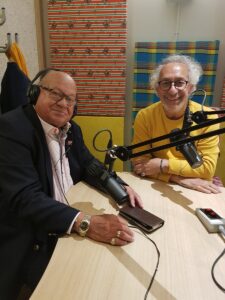
Orhan Galjus in his radio studio (August 2020)

Your work is connected to the South East Europe Media Organisation (SEEMO). You co-organised two SEEMO conferences about Roma media and journalism in South East and Central Europe. How important was this work of SEEMO for you?

It was so important very important! It was historical event in life of the Rroma media. I was so happy and proud to see so many activist who are doing pioneering journalism for community, I was so happy to see so many my colleagues and friends we had important work done from pioneering to serious issues addressing the development situation, struggles, challenges, I would recall to continue cooperation through very good plans made for that the Rromani media can reach their dreams.

Please walk us through a typical workday. How do you manage your time today?

Unavoidable drinking morning coffee with my mother (88) who check the “barometer” of social media, she says: “Dikh so si ani amari mahala” (look what happened in our mahala-street) in same time it is my opportunity to see “reports” from social media.

About noon I’m already consulting or talking, corresponding for the next Radio Patrin broadcasting. To many talks …

Attending only “must meetings”, about 19h at home, and again commentary from my mother: “why you are so late”? In this pandemic period, my mother so happy to see that Im working from home, Im NOT traveling as before …

Finally, as press freedom, human rights and democracy are very important in your life, can you give please some advice for younger journalists?

If you are not curious WHY, your journalistic engine is to slow!

19/11/2010: ALBANIA – ASSAULT ON JOURNALIST IN ALBANIA

September 29, 2020 disabled comments

Vienna, 19/11/2010

The South and East Europe Media Organisation (SEEMO), a network of editors, media executives and leading journalists from South and East Europe and an affiliate of the International Press Institute (IPI), denounces the recent assault on journalist Piro Nase, in the town of Gjirokastra, in Albania.

According to information received by SEEMO, Piro Nase, the journalist who heads the regional branch of the Albanian Union of Journalists in Gjirokastra, was physically and verbally assaulted by two alleged perpetrators on the evening of 14 November 2010.

Nase, who works for the newspaper Panorama and for TV Planet, was assaulted right after parking his car near his place of residence. It is alleged that two unknown persons suddenly appeared and started hitting him, punching him in the head. His face and jaw were showing signs of bruising the next morning.

SEEMO is alarmed by the fact that threatening statements such as “Let’s see if you will be more careful with what you write in that newspaper after tonight” allegedly accompanied the beating.

Commenting on the incident, SEEMO Secretary General Oliver Vujovic said: “SEEMO strongly condemns the physical assault on Nase and regards the attack as a blatant breach of press freedom. This was a criminal act which also constitutes an intolerable act of aggression against the fabric of society.”

“The press freedom situation in Albania remains distressing; the repeated occurrences of vicious physical attacks on journalists, such as this one, are particularly troubling. It is of paramount importance that the competent authorities investigate this assault and find the alleged perpetrators.”