
SEEMO MISSION TO TURKEY
Ankara, November 3, 2014
SEEMO Secretary General Oliver Vujovic visited Turkey. During this visit Vujovic met Prime Minister Ahmet Davutoğlu and the President of the opposition Republican People’s Party (CHP) party Kemal Kılıçdaroğlu.
The visit was part of a IPI / CPJ / SEEMO mission to Turkey. Turkey risks a serious backslide in democracy unless a recent trend of erosion of media freedom is reversed, the International Press Institute (IPI) warned today at the close of a joint press freedom mission to the country with the Committee to Protect Journalists (CPJ).
The warning followed a four-day mission in which an international IPI/CPJ delegation met with journalists, academics, attorneys and government representatives in Istanbul and Ankara, including President Recep Tayyip Erdoğan and Prime Minister Ahmet Davutoğlu.
Delegates from IPI and its affiliate, the South East Europe Media Organisation (SEEMO), welcomed the opportunity to reopen dialogue with Turkey’s government. But they said that the reports they heard during the mission painted a deeply troubling picture of the state of media freedom in the country. They also expressed disappointment in the aggressive and, at times, dismissive response by the president and the prime minister to well-documented instances of pressure on Turkish media outlets.
“Our visit has led us to the conclusion, however unfortunate, that not only is Turkey still a leading jailer of journalists in Europe, but also that other grave threats to media freedom have emerged since IPI conducted its last press freedom mission to Turkey in 2012,” Russian journalist and IPI Executive Board Chair Galina Sidorova said.
Sidorova, one of seven IPI Executive Board members that took part in the mission, added: “Government pressure – both direct and indirect – on journalists and media owners, a weakened system of checks and balances and a polarised political climate in which toxic, anti-media rhetoric is allowed to flourish have added to long-standing problems with media freedom in a country that touts its standing as part of the democratic world.”
IPI did, however, welcome several positive commitments made by Turkish officials. Prime Minister Davutoğlu told the delegation that Turkish journalists who received threats could turn to his office for support and that he would accept input from IPI and SEEMO on identifying legal provisions that do not meet international standards. IPI also welcomed a pledge by the country’s justice minister to allow an attorney from outside Turkey to conduct an independent review of the cases of journalists who remain behind bars.
“But we urge authorities to immediately release our colleagues, to stop imprisoning journalists and to end trials against them brought under the pretext of the ‘war on terrorism’, which has become a common official practice in dealing with critical reporting,” Sidorova said. “We similarly urge the Turkish government to reform restrictive anti-media legislation, including overly broad criminal and anti-terrorism laws that have been used to imprison a record number of journalists in recent years.”
During the visit Turkey’s leaders aggressively defended their record on press freedom issues, denying that they had applied undue pressure. They blamed media outlets for polarizing and distorting coverage of recent events such as the Gezi Park rallies, a government corruption scandal, and a recently resolved hostage situation in Iraq.
Officials criticized a variety of news outlets, from local newspapers to The New York Times and CNN International.
“Media should never have been given the liberty to insult,” said Erdoğan during a 90-minute meeting on Thursday at the Çankaya Köşkü presidential palace in Ankara.
The government committed to taking several steps to address concerns raised by the delegation. The Ministry of Justice agreed to continue reform of Turkey’s anti-press laws, and agreed to make available for independent legal review case files of imprisoned journalists.
“Although we disagree with government leaders on the role of news media, we are encouraged by their willingness to meet with us,” said CPJ board Chairman Sandra Mims Rowe, who led the joint delegation. “We welcome the commitments they made, and we believe officials recognize the depth of international concern.”
The delegation included board members Anne Garrels, special correspondent for NPR; David Schlesinger, former editor-in-chief of Reuters; Jacob Weisberg, chairman of The Slate Group; Andrew Alexander, former ombudsman at The Washington Post; Steven Isenberg, former publisher of New York Newsday; and Mhamed Krichen, Qatar-based anchor and program host for Al-Jazeera, Senior IPI Press Freedom Adviser Steven Ellis, Secretary General of the South East Europe Media Organisation Oliver Vujović, CPJ Executive Director Joel Simon and Europe and Central Asia Program Coordinator Nina Ognianova.
The Ministry of Justice informed the delegation that three journalists have recently been released from prison. CPJ has been able to independently confirm two of the releases. Today, Turkey is holding at least seven journalists, down from a high of 61 in August 2012, according to CPJ research. Many of those released are still facin charges and could again be imprisoned.
The delegation expressed concern about freedom of expression online. On Thursday, one day after members of the CPJ-IPI delegation met with President of the Constitutional Court of Turkey Haşim Kılıç, the court overturned new amendments to an Internet law, which would have allowed the country’s telecommunication authority to block websites swiftly and without a court order, and to collect and retain Internet users’ data, according to news reports.
Citing his concern that criminal and terrorist organizations, including the militant group Islamic State, are using the Internet to recruit followers, Erdoğan defended his government’s efforts to control online speech. “I am increasingly against the Internet every day,” he told the delegation.
In its meeting with Prime Minister Davutoğlu, the delegation noted that harsh statements from senior officials criticizing coverage have triggered vilification in the pro-government media, and sparked threats and attacks on social media, most recently against New York Times reporter Ceylan Yeginsu and Economist correspondent Amberin Zaman.
“If any journalists are under threat they can turn to my office and we will provide protection,” Davutoğlu said, adding, “Any threat to Amberin Zaman is a threat to me.”
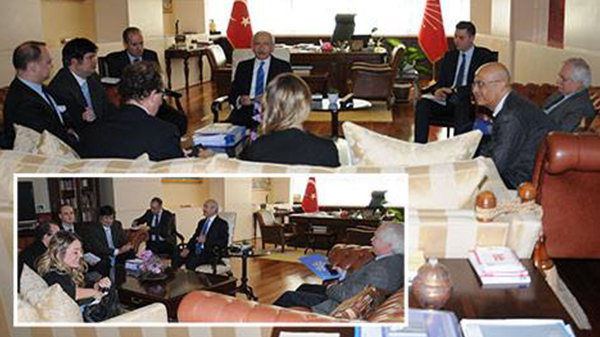
SEEMO Mission to Turkey – meeting with the Chief of CHP party