01.04.2024 – Serbian Journalist Threatened After Investigating Park Development

01.04.2024 – Serbian Journalist Threatened After Investigating Park Development

April 1, 2024 disabled comments

The South East Europe Media Organisation (SEEMO) condemns the threats made against journalist Gordana Momčilović Ilić from Stara Pazova, Serbia who was threatened after gathering data from municipal institutions regarding the legality of setting up facilities on the green area of a local public park.

Momčilović Ilić recounted to Journalists’ Association of Serbia (UNS – Udruženje novinara Srbije, www.uns.org.rs/) that on 27 March 2024, while standing on the street next to her bicycle, a car pulled up from which a woman emerged and threatened to kill her if she mentioned her brother again. “I was taken aback. I didn’t even get a chance to respond. As she left the parking lot, I managed to take a photo of the car to have its vehicle registration plate,” Momčilović Ilić told UNS.

She explained that for nearly two months she has been investigating and gathering documents under the Law on Free Access to Information of Public Importance regarding the cementing of green areas in the park and the installation of a 150-square-meter container. She emphasized that she had never mentioned anyone’s name during her investigation.

She began receiving messages on her personal Instagram profile praising the convenience of having a place to drink good coffee. “It’s not about coffee; I tried to explain the legality when someone addressed me on my personal Instagram profile. The question is about legality,” said the journalist to UNS. Momčilović Ilić reported the death threat to the police and gave a statement to the prosecutor’s office.

Gordana Momčilović Ilić is an anthropologist and ethnologist. In addition to her journalist work, she is also engaged in visual documentary work. She is a freelancer and writes articles for balkans.aljazeera (https://balkans.aljazeera.net/). You can read her articles here: https://balkans.aljazeera.net/author/gordana-momcilovic

The South East Europe Media Organisation (SEEMO) condemns the threats made against journalist Gordana Momčilović Ilić in Stara Pazova following her investigation about setting up a object in the local public park. Journalists must be able to conduct their work without fear of intimidation or violence. We stand in full support of UNS and Gordana Momčilović Ilić, advocating for press freedom and the safety of journalists. Such attacks not only undermine the fundamental principles of democracy but also obstruct the public’s right to information. SEEMO calls for swift and thorough action from Serbian authorities to investigate these threats and ensure the safety of journalists in Serbia. You can see the UNS article here: https://www.uns.org.rs/saopstenja/158206/uns-tuzilastvo-da-pokrene-postupak-zbog-pretnji-novinarki-gordani-momcilovic-ilic-iz-stare-pazove.html

South East Europe Media Organisation (SEEMO) is a regional non-governmental, non profit network of editors, media executives and leading journalists in Southeast, South, East and Central Europe. SEEMO members are in Albania, Armenia, Azerbaijan, Belarus, Bosnia-Herzegovina, Bulgaria, Croatia, Cyprus, Czech Republic, Estonia, Georgia, Greece, Hungary, Kazakhstan, Kosovo, Kyrgyzstan, Latvia, Lithuania, Malta, Moldova (with the territory of Transdnestria), Montenegro, North Macedonia, Poland, Romania, Russia, Serbia, Slovakia, Slovenia, Tajikistan, Turkmenistan, Türkiye / Turkey, Ukraine and Uzbekistan. Austria, Italy, Vatican and San Marino have a special status in SEEMO. SEEMO has over 3000 individual members, and additional media as corporate members.

#fyp #mediafreedom #seemo #freespeech #southeasteuropemediaorganisation #ngo #journalist #serbia #gordanamomcilovicilic #journalistattacked #SEEMO #pressfreedom #mediafreedom #freemedia
 

29.03.2024 – Graffiti Targeting N1 on Ministry Building in Belgrade, Serbia

March 29, 2024 disabled comments

On 26 March 2024, an incident came to light in central Belgrade, Serbia as graffiti bearing the message “N1 Evil”(“N1 Zlo”) was discovered adorning the facade of the Ministry of Public Administration and Local Self-Government building on Birčaninova Street in Belgrade, Serbia.

A journalist from N1 reached out to the Ministry via email, seeking clarification on its stance regarding the graffiti and any plans for its removal, but as of now, no response has been received.

This targeted act against N1 TV (https://n1info.rs/) underscores the persistent challenges faced by journalists striving to uphold press freedom in Serbia. Such incidents are not isolated, as evidenced by a pattern of attacks including the distribution of offensive leaflets, menacing messages on social media platforms, and now, the defacement of public buildings.

For example on 25 December 2023, there was an attack on N1 reporter Mladen Savatović during coverage of protests in central Belgrade, Serbia. Savatović recounted how a man in his mid-thirties aggressively approached him, making incomprehensible remarks before physically intimidating and verbally assaulting him.

This lack of engagement from public institutions raises troubling questions about their commitment to fostering an environment conducive to free and open discourse. It also highlights a broader trend of hostility towards journalists, not only from N1 but also from other media organizations critical of those in positions of power.

The South East Europe Media Organisation (SEEMO) strongly condemns the graffiti against N1 TV and is asking the Ministry of Public Administration and Local Self-Government to remove them from the building in Belgrade. It is unacceptable for any institution, especially a governmental one, to remain passive in the face of such blatant attempts to intimidate journalists and stifle independent reporting. SEEMO urges the authorities to promptly investigate this incident, hold the perpetrators accountable, and take concrete steps to ensure the safety and security of journalists in Serbia. Freedom of the press is a fundamental pillar of democracy, and any assault on it must be unequivocally condemned and met with swift and decisive action.

South East Europe Media Organisation (SEEMO) is a regional non-governmental, non profit network of editors, media executives and leading journalists in Southeast, South, East and Central Europe. SEEMO members are in Albania, Armenia, Azerbaijan, Belarus, Bosnia-Herzegovina, Bulgaria, Croatia, Cyprus, Czech Republic, Estonia, Georgia, Greece, Hungary, Kazakhstan, Kosovo, Kyrgyzstan, Latvia, Lithuania, Malta, Moldova (with the territory of Transdnestria), Montenegro, North Macedonia, Poland, Romania, Russia, Serbia, Slovakia, Slovenia, Tajikistan, Turkmenistan, Türkiye / Turkey, Ukraine and Uzbekistan. Austria, Italy, Vatican and San Marino have a special status in SEEMO. SEEMO has over 3000 individual members, and additional media as corporate members.

#fyp #mediafreedom #seemo #freespeech #southeasteuropemediaorganisation #ngo #journalist #serbia #N1TV #SEEMO #pressfreedom #mediafreedom #freemedia @n1srbija
28.03.2024 – Navigating Gendered Challanges: Female Journalists Reporting on Kosovo’s Complex Landscape

March 28, 2024 disabled comments

In a landscape fraught with security risks and conflicting interests, female journalists reporting in Kosovo encounter various forms of discomfort solely because of their gender: from invitations to evening outings and unwanted hugs to smear campaigns and threats of sexual violence. Speaking to Cenzolovka (https://www.cenzolovka.rs/), journalists Jelena Petković and Una Hajdari shed light on these challenges. Reporting on sensitive issues related to Kosovo poses numerous obstacles for journalists, with female reporters facing additional hurdles due to their gender.

Una Hajdari, a journalist reporting on Kosovo for international media outlets such as The New York Times (https://www.nytimes.com/international/), Politico (https://www.politico.com/), and The Boston Globe (https://www.bostonglobe.com/), notes the inherent misogyny ingrained in the attitudes of politicians towards complex political issues like dialogue, minority rights, and security matters. Hajdari recounts instances where politicians attempted to undermine her credibility and sideline her from events or press tours simply because of her gender. She further elaborates on the discomfort she has experienced during interviews, with ministers offering her alcohol in the middle of the day or inviting her to evening outings.

Similarly, Jelena Petković, a freelance journalist reporting on Kosovo highlights the gender discrimination faced by female journalists as just one aspect of the challenging working conditions in the region. Petković emphasizes the need for journalists to navigate a sea of security risks and competing interests, with their work scrutinized not just for its content but also for their name, the media outlet they represent, and the language they use.

Both journalists acknowledge the online attacks and smear campaigns they endure, with Una Hajdari noting that the transition from real-world harassment to online abuse amplifies the vitriol, particularly when it comes to misogynistic attacks on female reporters. Despite the challenges, Petković and Hajdari underscore the importance of objective reporting in empowering citizens with accurate information and holding politicians accountable for their actions.

Additionally, the article touches upon the experiences of local female journalists covering protests in northern Kosovo, highlighting the unique perspectives of Serbian and Albanian reporters amidst tensions in the region. The overall sentiment underscores the shared challenges experienced by female journalists irrespective of their ethnic background.

In conclusion, the article underscores the critical role of female journalists in providing accurate and unbiased reporting on Kosovo while navigating gender-based discrimination, online harassment, and political pressures. Despite these obstacles, journalists like Petković and Hajdari remain committed to their profession, striving to uphold journalistic integrity and inform the public about the complex realities of the region. You can read the full Cenzolovka article here: https://www.cenzolovka.rs/pritisci-i-napadi/novinarke-koje-izvestavaju-o-kosovu-politicki-i-etnicki-izazovi-ali-i-zato-sto-su-zene/

The South East Europe Media Organisation (SEEMO) stands in solidarity with female journalists reporting in the SEEMO region, including Kosovo. We extend our support to these courageous individuals who navigate through a landscape fraught with gendered obstacles and security risks, demonstrating resilience in the face of adversity.

South East Europe Media Organisation (SEEMO) is a regional non-governmental, non profit network of editors, media executives and leading journalists in Southeast, South, East and Central Europe. SEEMO members are in Albania, Armenia, Azerbaijan, Belarus, Bosnia-Herzegovina, Bulgaria, Croatia, Cyprus, Czech Republic, Estonia, Georgia, Greece, Hungary, Kazakhstan, Kosovo, Kyrgyzstan, Latvia, Lithuania, Malta, Moldova (with the territory of Transdnestria), Montenegro, North Macedonia, Poland, Romania, Russia, Serbia, Slovakia, Slovenia, Tajikistan, Turkmenistan, Türkiye / Turkey, Ukraine and Uzbekistan. Austria, Italy, Vatican and San Marino have a special status in SEEMO. SEEMO has over 3000 individual members, and additional media as corporate members.

#fyp #mediafreedom #seemo #freespeech #southeasteuropemediaorganisation #ngo #journalist #kosovo #jelenapetkovic #unahajdari #nytimes #politico #ifj #ipi #bostonglobe #femalejournalist #SEEMO #pressfreedom #mediafreedom #freemedia @jelenalp @UnaHajdari
27.03.2024 – Journalist Furkan Saliu Attacked by Executive Agent in North Macedonia

March 27, 2024 disabled comments

On 21 March 2024, in an incident in North Macedonia, journalist Furkan Saliu, who is working for PortaliX (https://portalix.mk/), was attacked while reporting in the city of Kichevo (Kičevo /Кичево / Kërçovë). The assailant, a woman, initiated the altercation, and took two microphones from the journalist. The journalist wanted a statement from the woman.

Following the attack, Saliu gave a statement at the police station and got back his microphones. Additionally, the prosecutor from Kichevo was promptly notified of the incident. You can see the video of the attack here: https://fb.watch/r1rowsDQt3/

In a subsequent turn of events, two woman who attacked Saliu, was apprehended by the authorities after reportedly engaging in a second physical altercation, this time targeting a police officer at the station.

The South East Europe Media Organisation (SEEMO) strongly condemns the attack on journalist Furkan Saliu. Violence against journalists cannot be tolerated in any society. Journalists must be able to carry out their professional duties without fear of intimidation or physical harm. SEEMO urges the authorities in North Macedonia to swiftly investigate this incident, hold the perpetrator accountable, and take decisive action to ensure the safety and security of journalists in the country.

South East Europe Media Organisation (SEEMO) is a regional non-governmental, non profit network of editors, media executives and leading journalists in Southeast, South, East and Central Europe. SEEMO members are in Albania, Armenia, Azerbaijan, Belarus, Bosnia-Herzegovina, Bulgaria, Croatia, Cyprus, Czech Republic, Estonia, Georgia, Greece, Hungary, Kazakhstan, Kosovo, Kyrgyzstan, Latvia, Lithuania, Malta, Moldova (with the territory of Transdnestria), Montenegro, North Macedonia, Poland, Romania, Russia, Serbia, Slovakia, Slovenia, Tajikistan, Turkmenistan, Türkiye / Turkey, Ukraine and Uzbekistan. Austria, Italy, Vatican and San Marino have a special status in SEEMO. SEEMO has over 3000 individual members, and additional media as corporate members.

#fyp #mediafreedom #seemo #freespeech #southeasteuropemediaorganisation #ngo #journalist #northmacedonia #FurkanSaliu #PortaliX #journalistattacked #SEEMO #pressfreedom #mediafreedom #freemedia @FurkanSaliu
26.03.2024 – Detention of Journalist Attila Aşut in Türkiye / Turkey

March 26, 2024 disabled comments

On 20 March 2024, columnist Attila Aşut from the BirGün (https://www.birgun.net/) has found himself under investigation for alleged involvement in “financing terrorism” after sending money to a prisoner convicted of terrorism-related charges. Aşut, who was briefly detained in Ankara, Türkiye / Turkey faced questioning regarding his financial assistance to Süleyman Erol, a prisoner serving a 25-year sentence for affiliation with the Revolutionary People’s Liberation Party-Front (DHKP-C). The police revealed that Aşut had sent a total of 600 TRY (17.26 EUR) to Erol, sparking concerns about his connections and motives. Aşut clarified that he sent the money solely for humanitarian purposes, emphasizing Erol’s educational achievements during his incarceration. Despite assertions of innocence, Aşut faced inquiries about his alleged ties to DHKP-C.

Furthermore, Aşut was questioned about his phone conversations he had several years ago with journalists Güray Tekin Öz and Erdem Gül, both of whom have faced terrorism-related charges.

Following his statement to the police, Aşut was released without being referred to the prosecutor’s office.

The South East Europe Media Organization (SEEMO) is monitoring this case.

South East Europe Media Organisation (SEEMO) is a regional non-governmental, non profit network of editors, media executives and leading journalists in Southeast, South, East and Central Europe. SEEMO members are in Albania, Armenia, Azerbaijan, Belarus, Bosnia-Herzegovina, Bulgaria, Croatia, Cyprus, Czech Republic, Estonia, Georgia, Greece, Hungary, Kazakhstan, Kosovo, Kyrgyzstan, Latvia, Lithuania, Malta, Moldova (with the territory of Transdnestria), Montenegro, North Macedonia, Poland, Romania, Russia, Serbia, Slovakia, Slovenia, Tajikistan, Turkmenistan, Türkiye / Turkey, Ukraine and Uzbekistan. Austria, Italy, Vatican and San Marino have a special status in SEEMO. SEEMO has over 3000 individual members, and additional media as corporate members.

#fyp #mediafreedom #seemo #freespeech #southeasteuropemediaorganisation #ngo #journalist #turkey #Türkiye #birgun #AttilaAşut #journalistdetained #journalistinprison #SEEMO #pressfreedom #mediafreedom #freemedia
25.03.2024 – Graffiti Rewritten at Dinko Gruhonjić’s Building Entrance

March 25, 2024 disabled comments

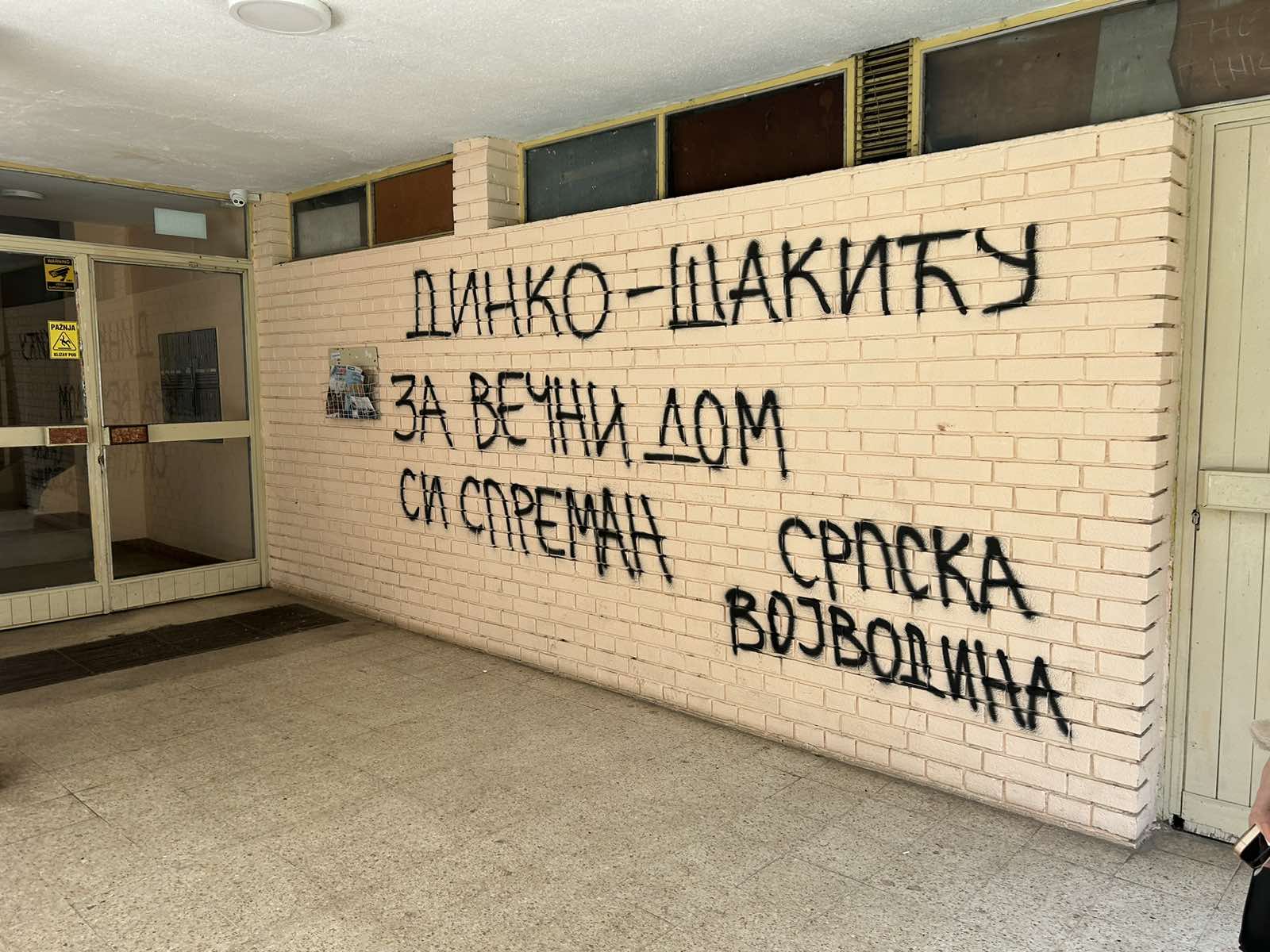
On 21 March 2024 in Novi Sad, Serbia recent events have once again brought to light the challenges faced by journalists, particularly Dinko Gruhonjić, who is Program Director of the Independent Journalists’ Association of Vojvodina (NDNV – https://ndnv.org/), journalist at Autonomija portal (https://autonomija.info/), and University professor in Novi Sad, Serbia. Threatening graffiti were written at the building where he lives in Novi Sad, Serbia.

The graffiti represents not just verbal harassment, but a tangible threat to Gruhonjić’s safety and well-being.

Once again, after citizens had repainted over a previous graffiti on the night of 23 March 2024 new graffiti was inscribed at the entrance of the building of journalist Dinko Gruhonjić. On the wall, in red paint, it was written “You painted for nothing! Liman.”

This latest incident is not an isolated one; rather, it is part of an ongoing pattern of intimidation and hostility directed towards Gruhonjić and other journalists in Serbia. It is worth noting that Gruhonjić has been subjected to similar acts of intimidation in the past, indicating a troubling trend of harassment and aggression aimed at silencing dissent and stifling press freedom in the region.

The South East Europe Media Organisation (SEEMO) condemns such reprehensible behavior and stands in solidarity with Gruhonjić and all journalists who face similar threats and intimidation in Serbia. Freedom of the press is a fundamental pillar of democracy, and any attempt to undermine it must be met with swift and decisive action. We urge the authorities to thoroughly investigate this matter and hold those responsible accountable for their actions. Journalists must be able to carry out their work without fear of reprisal, and it is incumbent upon society as a whole to uphold and protect their rights and freedoms.

South East Europe Media Organisation (SEEMO) is a regional non-governmental, non profit network of editors, media executives and leading journalists in Southeast, South, East and Central Europe. SEEMO members are in Albania, Armenia, Azerbaijan, Belarus, Bosnia-Herzegovina, Bulgaria, Croatia, Cyprus, Czech Republic, Estonia, Georgia, Greece, Hungary, Kazakhstan, Kosovo, Kyrgyzstan, Latvia, Lithuania, Malta, Moldova (with the territory of Transdnestria), Montenegro, North Macedonia, Poland, Romania, Russia, Serbia, Slovakia, Slovenia, Tajikistan, Turkmenistan, Türkiye / Turkey, Ukraine and Uzbekistan. Austria, Italy, Vatican and San Marino have a special status in SEEMO. SEEMO has over 3000 individual members, and additional media as corporate members.

Photo source: Dinko Gruhonjić- X

#fyp #mediafreedom #seemo #freespeech #southeasteuropemediaorganisation #ngo #journalist #serbia #novisad #vojvodina #dinkogruhonjic #autonomija #journalistattacked #SEEMO #pressfreedom #mediafreedom #freemedia @DinkoGruhonjic
23.03.2024 – Report Reveals Pressures Faced by Journalists in Serbia

March 23, 2024 disabled comments

A recent report sheds light on the myriad challenges journalists in Serbia encounter in their line of work.

Journalists in Serbia assess the reaction of state authorities in cases of reported security threats as inadequate (90%), and 75% of respondents say that the attitude of state authorities towards them (when they reported threats) was more or less negative. Among journalists who have experienced threats due to their work in the past year, the largest number of threats came either from anonymous senders (14.1%) or from people who declare themselves as supporters of a political party (14.1%), followed by threats from public officials (13.1%) and ordinary citizens (13.1%), and 12.1% of journalists who were threatened received these threats from politicians.

Journalists identify the origins of threats in the hindrance of text or article publication, (35%) of documented instances, or influence on media content (32.5%). Among those subjected to threats, attacks, and pressures, one in four attested to a discernible impact on their physical health (25%). Additionally, 40% reported observable modifications in behaviour, characterised by heightened states of anxiety, discomfort, and trepidation. Moreover, 20% acknowledged a reduction in job satisfaction stemming from these.

According to the findings, institutional pressures rank as the most common threat, affecting 46.2% of journalists, followed closely by economic pressures and job insecurity at 40.2%. Targeting and smear campaigns affect 29.9% of journalists, while 30.5% face verbal threats regularly. Shockingly, 17.1% of journalists have experienced Strategic Lawsuits Against Public Participation (SLAPPs). Digital violence has impacted 39.2% of journalists surveyed. Notably, over half of journalists (53.8%) have refrained from reporting on certain topics due to fears, with women journalists reporting higher instances.

39.5% of journalists admitted that they had repeatedly decided not to report on a topic or event, and another 14.3% stated that they had once been in such a situation. This means that a majority of journalists (53.8%) stated that they were in a situation where they did not report on a topic or event once or more, and 43.7 journalists did not report such experience. This question was not answered by 2.5% of journalists. Women journalists report above average that they have been in this situation once or more.

Conversely, a significant majority of journalists (68.7%) asserted that self-censorship has had an impact on both their professional undertakings and the quality of information conveyed to the public, of which 28.1% refraining from publishing intended stories, 26.6% stated that selfcensorship limited the scope and importance of the story, and for 14.1% self-censorship resulted in an absence of vital information for the public.

The report was developed as part of the action “Protecting freedom of expression and of the media in Serbia (PROFREX)” under the Council of Europe’s Division for Co-operation on Freedom of Expression and prepared with the support of the Council of Europe and European Union. The report was conducted in collaboration with the Journalists Association of Serbia (UNS – https://uns.org.rs/) and the Independent Journalists Association of Serbia (NUNS – https://nuns.rs/). The survey involved 130 journalists and media employees. By delving into these complex dynamics, the report seeks to enhance understanding of the challenges journalists face in Serbia’s media landscape. In an era dominated by digital communication, safeguarding freedom of expression is paramount. Recognizing and addressing covert pressures like self-censorship is essential for upholding journalistic integrity and preserving democratic values.

The report is online:

https://rm.coe.int/hf42-research-threats-attacks-on-journalists/1680aee322

The South East Europe Media Organisation (SEEMO) underscores the paramount importance of safeguarding freedom of expression and protecting journalists’ rights. The prevalence of institutional pressures, economic insecurities, and digital violence underscores the urgent need for robust measures to defend press freedom. SEEMO reaffirms its commitment to advocating for the rights of journalists and ensuring their safety in the pursuit of truth and transparency. Without unfettered access to information and the ability to report freely, democratic values are jeopardized, and societal progress hindered. SEEMO calls upon authorities and stakeholders to address these issues promptly and comprehensively, fostering an environment where journalists can work without fear of reprisal or censorship.

South East Europe Media Organisation (SEEMO) is a regional non-governmental, non profit network of editors, media executives and leading journalists in Southeast, South, East and Central Europe. SEEMO members are in Albania, Armenia, Azerbaijan, Belarus, Bosnia-Herzegovina, Bulgaria, Croatia, Cyprus, Czech Republic, Estonia, Georgia, Greece, Hungary, Kazakhstan, Kosovo, Kyrgyzstan, Latvia, Lithuania, Malta, Moldova (with the territory of Transdnestria), Montenegro, North Macedonia, Poland, Romania, Russia, Serbia, Slovakia, Slovenia, Tajikistan, Turkmenistan, Türkiye / Turkey, Ukraine and Uzbekistan. Austria, Italy, Vatican and San Marino have a special status in SEEMO. SEEMO has over 3000 individual members, and additional media as corporate members.

#fyp #mediafreedom #seemo #freespeech #southeasteuropemediaorganisation #ngo #journalist #serbia #coe #eu #slapp #journalistattacked #SEEMO #pressfreedom #mediafreedom #freemedia
 

23.03.2024 – Albanian Prime Minister Edi Rama Under Fire for Physical Contact with Journalist: Press Freedom Concerns Arise

March 23, 2024 disabled comments

On 19 March 2024, Albanian Prime Minister Edi Rama has come under scrutiny following an incident involving journalist Ambrozia Meta from Syri TV (https://www.syri.net/), in which an video footage that is online captured Rama avoided her question and making physical contact with the journalist – touched her face. The incident occurred during a press statement. You can see the video here: https://twitter.com/xhemajl_rexha/status/1770037270604550414 .

Meta asked him about a project on the island of Sazan in Albania where it has been reported that a foreign company will build properties for the tourist trade.

In response to this video, Prime Minister Rama said over his X (former Twitter) – @ediramaal – account:

Apologies?! Apologies following a completely abhorring lie while everything is in video and a dozen of journalists, and cameramans as well are eyewitnesses of the simple truth that not only there was anything near to an agression, but all questions were answered patiently (despite the several unthetical interruptions) in a usual talk to the press and I left after a friendly goodbye?! No I am sorry and not only I have no apologies to make, but I reject the whole characterization of “the leader that has shown contempt toward critical press”, which is simply not true because there are now many years since I don’t engage in any type of legitimate heated debate with any journalist:-) On the contrary I show to the many ethical as well as to sometimes unethical journalists my full disponibility to answer all questions, although the late category is used to disruptive and clearly out of any standard continous interruptions of answers. So sorry that such a “denounciation” does not honour the values of freedom and either the truth, but more then that denounciating an imaginary agression direspects the true victims of power agressions toward women journalists around the world. As for the “inexcusable” behaviour, as a former free press pionieer in my country when my free speech risked my own life, I feel fully intitled to say that press organizations should care to protect the values of freedom, democracy and journalistic integrity not only when they are threatened by power, but also when they are undermined by members of the press community. Otherwise our democratic societies are really in trouble.

You can read his statement here: https://twitter.com/ediramaal/status/1770090436767437072

The incident has reignited discussions about press freedom and the relationship between government officials and the media in Albania. Many are calling for a thorough investigation into the matter and expressing concerns about the implications for freedom of expression in the country. As the controversy continues to unfold, it underscores the challenges facing journalists and the press in Albania in their pursuit of truth and accountability.

The South East Europe Media Organisation (SEEMO) is monitoring developments connected to this case. Such actions set a concerning precedent for the treatment of journalists. Journalists must be able to carry out their duties without fear of pressure or physical interference from government officials.

South East Europe Media Organisation (SEEMO) is a regional non-governmental, non profit network of editors, media executives and leading journalists in Southeast, South, East and Central Europe. SEEMO members are in Albania, Armenia, Azerbaijan, Belarus, Bosnia-Herzegovina, Bulgaria, Croatia, Cyprus, Czech Republic, Estonia, Georgia, Greece, Hungary, Kazakhstan, Kosovo, Kyrgyzstan, Latvia, Lithuania, Malta, Moldova (with the territory of Transdnestria), Montenegro, North Macedonia, Poland, Romania, Russia, Serbia, Slovakia, Slovenia, Tajikistan, Turkmenistan, Türkiye / Turkey, Ukraine and Uzbekistan. Austria, Italy, Vatican and San Marino have a special status in SEEMO. SEEMO has over 3000 individual members, and additional media as corporate members.

#fyp #mediafreedom #seemo #freespeech #southeasteuropemediaorganisation #ngo #journalist #albania #syritv #edirama #AmbroziaMeta #journalistattacked #SEEMO #pressfreedom #mediafreedom #freemedia
20.03.2024 – SEEMO Condemns Arson Attack on Media Owner Vehicle in Kosovo

March 20, 2024 disabled comments

In Leposaviq / Leposavic, Kosovo, a disturbing incident unfolded on the night between Saturday and Sunday 16-17 March 2024, as the vehicle belonging to Dušan Milanović, the owner of VIM Info and the founder of the Kosovo Online portal (https://www.kosovo-online.com/), was discovered burned. Kosovo Police were swiftly informed of the incident and have launched an investigation to find the perpetrators behind this malicious act.

The circumstances surrounding the burning of Milanović’s vehicle remain shrouded in mystery, prompting widespread speculations. The Kosovo Online editorial team has taken a cautious approach, refraining from drawing premature conclusions or linking the incident to Milanović’s professional activities. Instead, they are urging the competent authorities to conduct a comprehensive investigation to determine the motive behind the arson and bring those responsible to justice.

The gravity of the situation has not gone unnoticed, with concerns mounting over the safety and security of individuals involved in media and journalism within Kosovo.

According to Kosovo Online, Veton Elshani, the Deputy Commander of the Kosovo Police for the North Region, confirmed the incident, shedding light on the timeline of events. According to him, the police received a call in the early hours of the morning and reacted immediately. Upon arrival, they discovered Milanović’s vehicle engulfed in flames, with significant damage inflicted upon the engine.

Only a little more than two weeks ago, the car belonging to a local Serbian administrative staff member in Leposaviq / Leposavic, Radmila V., was also in the early morning hours set on fire.

Kosovo online portal is owned by VIM INFO d.o.o. from Zveçan /Zvečan in Kosovo. It has a registration by the Business Registration Agency of Kosovo (BRAK) in Pristina, Kosovo, from 26 July 2019. Business Registration Agency of Kosovo operates within the Ministry of Trade and Industry of Kosovo, It has also an registration by the Agency for Economic Registers (APR) of Serbia in Belgrade from 14 August 2019. Kosovo online is publishing news on Serbian, Albanian and English. More details about the registration of the VIM INFO company are online in the Kosovo Media Ownership Monitory published by the Balkan Investigative Reporting Network – BIRN in Kosovo: https://kosovo.mom-gmr.org/en/owner/companies/detail/company/company/show/vim-info-doo-1/

The South East Europe Media Organisation (SEEMO) is monitoring the case and is asking for a fast investigation to identify and prosecute the perpetrators responsible for this act.

South East Europe Media Organisation (SEEMO) is a regional non-governmental, non profit network of editors, media executives and leading journalists in Southeast, South, East and Central Europe. SEEMO members are in Albania, Armenia, Azerbaijan, Belarus, Bosnia-Herzegovina, Bulgaria, Croatia, Cyprus, Czech Republic, Estonia, Georgia, Greece, Hungary, Kazakhstan, Kosovo, Kyrgyzstan, Latvia, Lithuania, Malta, Moldova (with the territory of Transdnestria), Montenegro, North Macedonia, Poland, Romania, Russia, Serbia, Slovakia, Slovenia, Tajikistan, Turkmenistan, Türkiye / Turkey, Ukraine and Uzbekistan. Austria, Italy, Vatican and San Marino have a special status in SEEMO. SEEMO has over 3000 individual members, and additional media as corporate members.

#fyp #mediafreedom #seemo #freespeech #southeasteuropemediaorganisation #ngo #journalist #kosovo #dusanmilanovic #kosovoonline #journalistattacked #journalistthreat #SEEMO #pressfreedom #mediafreedom #freemedia @KosovoOnline

19.03.2024 – Journalist Threatened with Death in Albania

March 19, 2024 disabled comments

Isa Myzyraj (@IsamyzyrajAlb), a journalist at Ora News (https://www.oranews.tv – @rtvora) , photo reporter, as also a human rights activist, who worked in the past for Dritare TV (https://dritare.net), received a life-threatening email on Tuesday 12 March 2024, raising concerns about press freedom and safety in Albania.

The email, containing hateful language, anti-Semitic, and homophobic remarks, was sent to both Myzyraj’s personal account and Ora News TV newsroom. The sender appears to be of foreign origin. Among other things it was written “we will do to Isa like Hitler did”

Speaking to Balkan Investigative Reporting Network (BIRN – https://birn.eu.com/news-and-events/), Myzyraj expressed certainty that the threat stemmed from his work as a journalist and activist. He noted that the email also targeted his employers, suggesting a possible link to his professional activities.

In response to the incident, Deputy of the Democratic Party of Albania (Partia Demokratike e Shqipërisë – PDSh / PD) Ina Zhupa called for swift action to identify and apprehend the perpetrator. Zhupa, a member of the media commission, condemned the threat, emphasizing the need to protect journalists who work in the public interest.

As the case unfolds, questions about press freedom and journalist safety in Albania come to the forefront. It remains crucial for authorities to ensure the safety and security of journalists and uphold the principles of freedom of speech and expression.

The South East Europe Media Organisation (SEEMO) condemns the threats against Isa Myzyraj, a journalist at Ora News and a human rights advocate in Albania. The organization expresses grave concern over the recent email containing hateful and discriminatory language, which not only targeted Myzyraj personally but also posed a direct threat to press freedom and journalistic integrity in Albania. SEEMO calls upon Albanian authorities to swiftly investigate this matter, identify the perpetrators, and ensure that they are held accountable for their actions. Journalists must be able to carry out their duties without fear of intimidation or reprisal, and SEEMO stands in solidarity with Myzyraj and all journalists in Albania who uphold the principles of press freedom and democracy.

South East Europe Media Organisation (SEEMO) is a regional non-governmental, non profit network of editors, media executives and leading journalists in Southeast, South, East and Central Europe. SEEMO members are in Albania, Armenia, Azerbaijan, Belarus, Bosnia-Herzegovina, Bulgaria, Croatia, Cyprus, Czech Republic, Estonia, Georgia, Greece, Hungary, Kazakhstan, Kosovo, Kyrgyzstan, Latvia, Lithuania, Malta, Moldova (with the territory of Transdnestria), Montenegro, North Macedonia, Poland, Romania, Russia, Serbia, Slovakia, Slovenia, Tajikistan, Turkmenistan, Türkiye / Turkey, Ukraine and Uzbekistan. Austria, Italy, Vatican and San Marino have a special status in SEEMO. SEEMO has over 3000 individual members, and additional media as corporate members.

#fyp #mediafreedom #seemo #freespeech #southeasteuropemediaorganisation #ngo #journalist #albania #oranews #isamyzyraj #journalistattacked #journalistthreat#SEEMO #pressfreedom #mediafreedom #freemedia @OraNewsRTV @IsamyzyrajAlb