
Interview with SEEMO Member Goran Mihajlovski (September 2020)

Interview with SEEMO Member Goran Mihajlovski (September 2020)

September 11, 2020 disabled comments

If you are willing to compromise with the truth, don’t become a journalist.

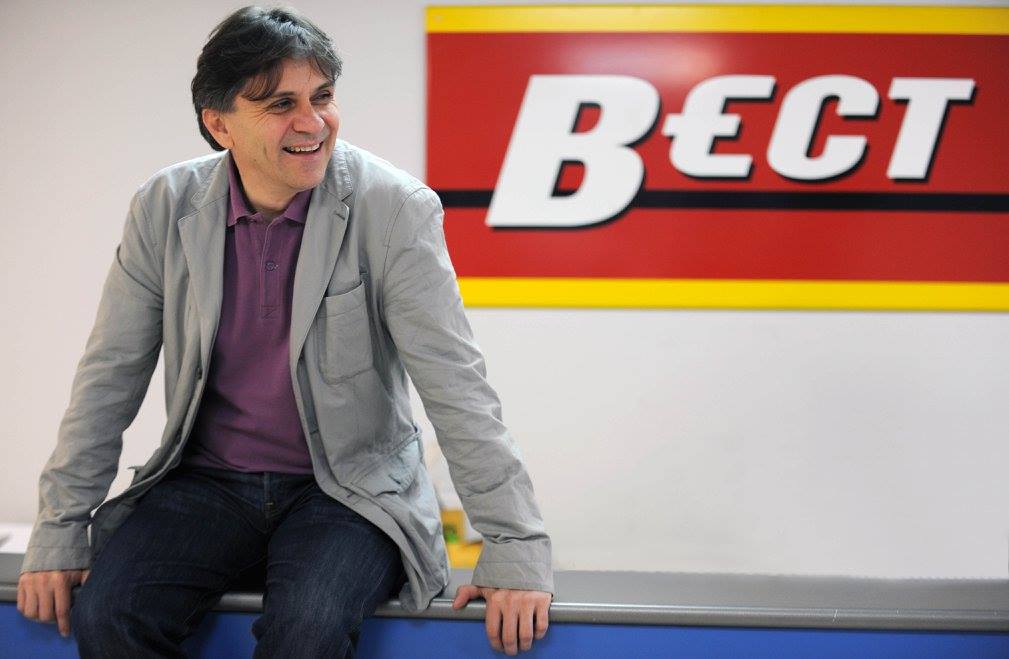
Interview with SEEMO Member Goran Mihajlovski , Editor in Chief WWW.SDK.MK, Skopje, North Macedonia (September 2020)
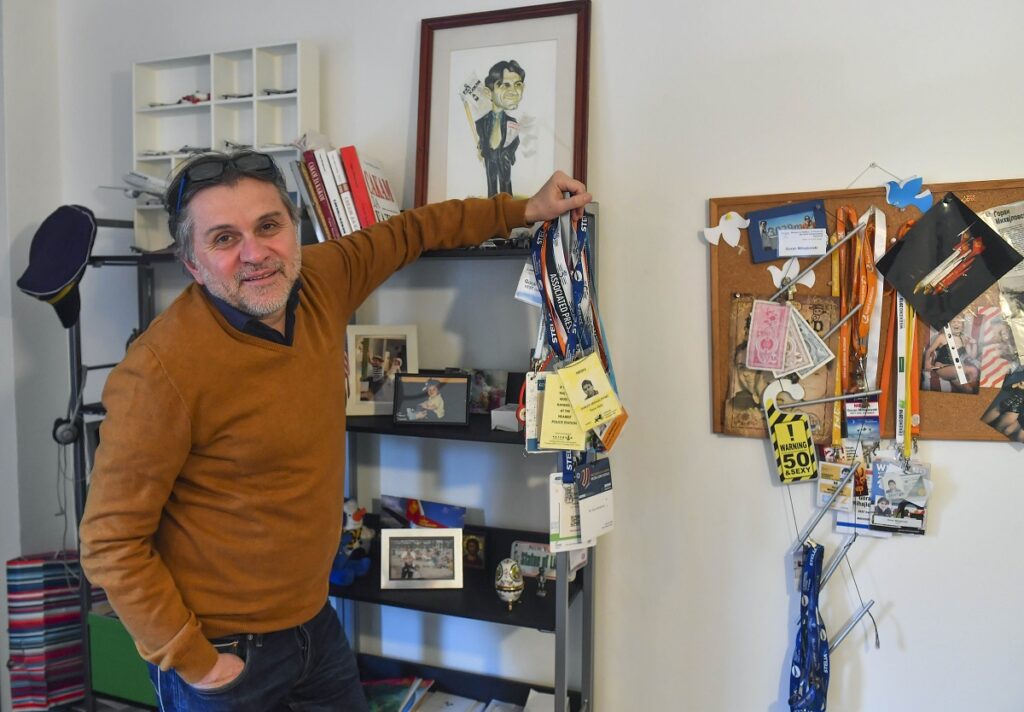
Tell us a little about yourself, your family, including how you got started as a journalist?

– I’m married to an architect and we have two teenagers at home, a daughter and a son. I have been a journalist almost my whole life, ever since I finished high school. As a young journalist student, in the 1980s I worked as a reporter while serving in the Yugoslav Army, for the Army’s magazine “Vojnik” in Belgrade. When I was doing my University studies I was freelancing at the student’s weekly magazine “Studenski zbor”. I am in “serious” journalism since I got my first salary in “Vecer” daily newspaper in 1989.

What is the difference between journalism when you started and today?

– There shouldn’t be any difference between journalism then and now as long as you follow the principles of the profession. The only difference is in the technical tools. In the past, we relied on landline phones, telegraphs, stenographs, later on we got the fax machines, pagers and now we are more dependent on mobile phones and the Internet. It’s easier to run journalism with the new technological tools because it gives us a lot of advantages when it comes to sources and accessing archives. But, at the same time, with so much information from so many sources the risk for manipulation is bigger, so you have to be more careful what you read and always check if that is true.

You met also many important persons. Maybe if you can present some of them.

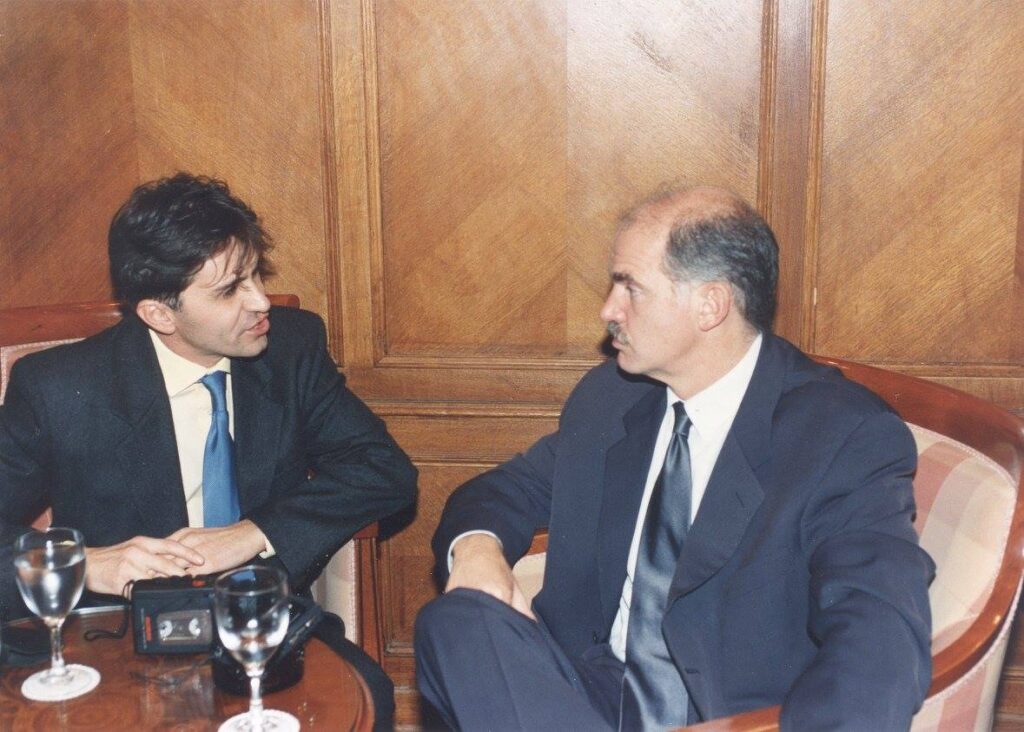
– I started as a journalist in a political section at the time when Yugoslavia was falling apart, during the wars in the ex-Yugoslav republics when Republic of Macedonia was fighting for independence and international recognition. The most notable person that I have worked with is Kiro Gligorov, the first President of the independent Republic of Macedonia. But, at that time during the famous peace conferences for Yugoslavia around Europe, including the Macedonian city of Ohrid, I had the chance to meet and take statements from Franjo Tudjman (President of Croatia), Slobodan Milosevic (President of Serbia), Alija Izetbegovic (President of Bosnia and Herzegovina)… Later on, in 1999 when there was softening of the Macedonian relations with Greece, I interviewed George Papandreou in Athens when he was the Minister of Foreign Affairs. Several times I’ve had useful meetings and off-the record briefings with the long-term UN mediator in the Macedonian-Greek negotiations over the name issue Mathew Nimetz.
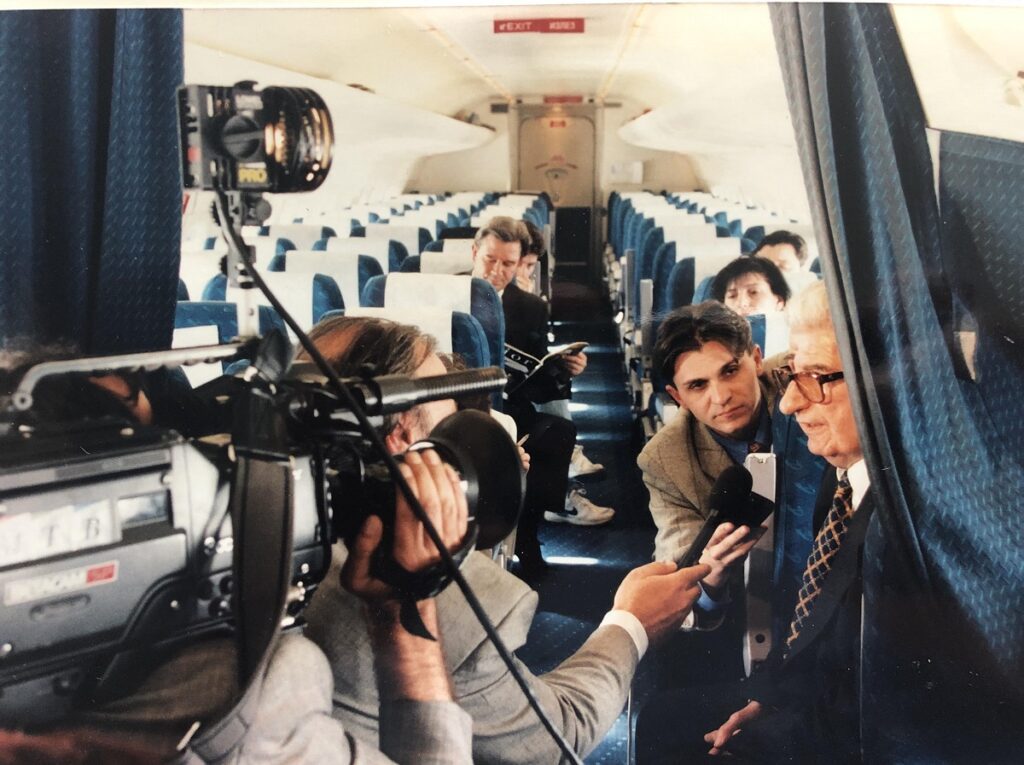
What was your biggest challenge as journalist?

– The biggest challenge was to fight huge personal pressure and censorship, while being determined to keep my voice and to maintain integrity both personal and of the journalistic profession. And most importantly, to keep my name clean.

How hard it was to stay always professional?

– If you are a journalist at heart, if you are determined to live from journalism, if the job makes you happy, if you don’t mind working without defined working hours and, last but not least, if you stick to the principles and standards, it’s not hard to stay a professional journalist.

Did you make some mistakes? Would you do something today different?

– I work in online journalism, in the hurry of being first, of being exclusive I might have made some mistakes, but none were big enough to take a toll on my career. If you stand by the principles of journalism, if you seek confirmation from a reliable source, the risk of making a mistake is minimal. It is always better, even if you are sure of it, not to rush with the publishing until you have confirmed the credibility of the news.

Your work is connected to the South East Europe Media Organisation (SEEMO). How important is SEEMO for you?

– SEEMO has a great role in securing much needed regional networking of the journalists and media outlets. It creates close contacts as well as serving as a watchdog for breach of press freedoms. In my opinion, such support and role are crucial considering the circumstances and the challenges we face as journalists on daily level.

How you see the role of online media today?

– The role of online media is the same as any other media today and always: it is only professional newsrooms that maintain the constant struggle to keep the integrity of journalism with credible and fact-checked reporting. Media is not only there to inform properly, but to give voice to all citizens and correct malpractices in the society.
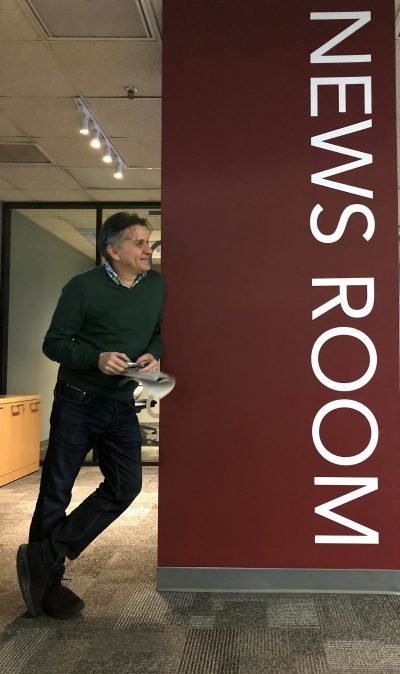
You are working for SDK. MK digital newsroom. Can you please present us your media?

– SDK.MK is a digital newsroom that sticks to highest standards of professional journalism. It consists of eight journalists in the Skopje headquarters, along with an original local correspondent network of eight reporters covering 8 regions in the country. We also have two professional photo-reporters. What makes us different from other online media outlets in North Macedonia is that we don’t bait our readers with clickbait titles, and yet we are among those with the highest engagement rate. We stick by the rule: We don’t copy, we doublecheck and we don’t waste our readers’ time with nonsense.

You are also founder of Vest Daily, the biggest daily newspaper in North Macedonia. You started with Vest in the year 2000. Was it hard to start a new newspaper?

– Every beginning is hard and brings unforeseen situations. However, I knew exactly the sort of newspaper I wanted to create. My first investor, the Macedonian company “Fershped”, trusted me when I told them that we would quickly become the newspaper with the highest circulation and most importantly they didn’t involve themselves in my editorial policy. I chose a team of young, free-minded journalists, who accepted my philosophy of being different from the others by revealing more than the ordinary news. And we succeeded.

Tell us a little more about your time in Vest and why you ended the cooperation in the year 2015.

– I founded Vest in 2000 with a team of experienced editors as well as very young reporters and by 2005 it became the best-selling newspaper in the country. It was highly regarded by the public as a free voice, bold and open minded, with remarkable professional credibility and integrity. In 2005 it became part of the WAZ media group in Macedonia and that was the best period of the Macedonian journalism. However, in 2012 WAZ sold its Macedonian newspapers to a company close to the ruling regime of VMRO-DMPNE and soon the regime cracked down the press freedom along every line. It was a true battle on daily basis to maintain our professional standards and integrity, and we literally had to “smuggle news” and fight censorship. When my contract ended at the end of 2015, the management fired me, and a year later they closed down Vest and all the newspapers from the former WAZ group. That was the worst, darkest period of the Macedonian journalism, and Macedonia was rated as a Not free country both by RSF and Freedom House.
seemo-newsroom

From 1989 till 2000 you worked in Vecer daily. It was still the “old Yugoslavia” when you started to work. What was different in journalism when you started in 1989 and when you ended the work in Vecer in 2000?

– Vecer, although it was published in the former communist system, had more liberty than other media at that time. When I got my job there the system and the country were falling apart. I was lucky to have had editors who supported a change in the system and the independence of Macedonia. I was young and I didn’t really have an emotional link to the former system, nor did I fear authorities from “above” because I did not know them personally. So, quickly my articles were on the front page and from the 12th January 1991 I started writing my column “Sakam da kazam” (I Want to Say) which was published every Saturday. In fact, the column which marked my career is a witness of the historical twist of Macedonia. I left Vecer in 2000 because it was still property of the state, for a short time I was even the Editor in Chief, I wasn’t under pressure, but I didn’t see any growth potential.

How you would describe the difference of the daily Vecer and Vest?

– Both Vecer and Vest were popular newspapers. In fact, Vest was sort of better, upgraded Vecer, with bolder approach, more shocking, a newspaper that surprises, that breaks barriers, fighting against the modern day double standards and hypocrisy, much more liberal than other newspapers, simply put, Vest was a newspaper with no boundaries. However, I learned the principles of journalism and the skill of writing bold titles from Vecer and my first editors Zlatko Blayer and Aleksandar Ivanovski, and I am forever grateful to them for all my professional achievements.
Did politicians try to influence your work, especially in the time when you worked for Vest? If yes, how you reacted?

– Politicians will always like to have influence. In fact, the relationship between journalists and politicians is a two-way street. They need you for publicity, you need them as a source. Actually, in Vest I didn’t have any political pressure while the owner of the newspaper was “Fershped” and later the German corporation WAZ. But in 2012, when the newspaper was sold to the local businessman Orce Kamcev, who had business relations with the government of Nikola Gruevski, the pressure was rising by the minute and at the end they became very brutal. As I mentioned earlier, every day in the newsroom we thought about not what to unveil, but rather how to hide what we had already unveiled. To put it on page 6 in the lower left corner, to send the front page after the printing deadline so the printing facility wouldn’t have time to stop etc. We became experts at self-censorship and yet we were not giving up our determination to inform the public correctly. Our final goal was to get out of that madness with a clean reputation, regardless of how long that madness could have lasted. We fought hard in order not to put a stain on journalism and not to put a stain on ourselves as professional journalists.

Please walk us through a typical workday. How do you manage your time today?

– There is no typical workday for a journalist. Sometimes you are overwhelmed with work, sometimes you have a lazy day. We meet at the newsroom around 10 o’clock in the morning, we contact our local correspondents, we analyze the visits on the website and the engagement on social media… This is a digital newsroom. Working hours don’t end with a deadline, when you send in the last pages to the printing facilities, but we have to write an article and publish it at any hour of the day.

How you see the media situation in your country today?

– Not good. A devasted public service, too many private television companies struggling to survive on the media market with soap operas and reality shows along with hundreds of “copy-paste one-man-show” web portals that are founded and perish with each election cycle.

And political situation in North Macedonia in the past 20 years?

– As the country normalized relations with Greece and became a member of NATO, I am convinced that we finally have a chance to move forward.

And worldwide? Media and political situation today?

– Our mutual enemy are not only the fake news, but also the news from irrelevant news sources. In addition to the lazy, not fact-checked, copy-paste journalism. There are readers who are not media literate. But, how do we educate them and teach them to read with caution and to learn how to recognize fake from real news when even the journalists writing the news are illiterate?

How you see the future of media? Especially print media.

– I don’t think there is future for daily newspapers. However, there’s still a chance for magazines, reviews, special editions, specialized newspapers… You can’t make someone concentrate on important interviews, in- depth cover stories, extensive reportages over the phone. At least for me, I still get excited from the smell of a newspaper and print and really appreciate a neatly done article with sophisticated graphic design and quality photos.

Finally, as press freedom and democracy are very important in your life, can you please give some advice for younger journalists?

– If you are willing to compromise with the truth, don’t become a journalist.
Boris Bergant 2

September 10, 2020 disabled comments

born 1948

Media Adviser

Deputy Director General RTV SLO 1989-2006

1990-1992 President of Circom Regional, European Association of Regional Television
1995-2001 Secretary- General, Circom Regional
1998-2008 Vice President of the European Broadcasting Union (EBU/UER)
2009- Senior Consultant, EBU
working as consultant for broadcasting management, content, organisation
( developed Strategies of Public Service Media in Slovenia, Moldova,Georgia, Serbia, Montenegro, Ukraine )
consulting media in Serbia, Slovakia, FYR Macedonia, Armenia, Kyrgistan, Bosnia and Hercegovina, Kosovo, Cyprus, Portugal, Austria, Italy
Representative of the Republic of Slovenia in different media committees of the Council of Europe ( 2004-2008 Chairman of the Standing Committee on Transfrontier Television).
Experience in journalism: journalist by profession, President of the Slovenian Journalist Association (1987-1992).
Awarded with high remuneration’s for journalistic work:
Tomšičeva nagrada for the best journalistic achievement in Slovenia, rewards at the TV festivals Monte Carlo, New York, Leipzig
Busek Award for outstanding achievements

Publishing in the field of foreign politics and broadcasting

QUO VADIS PUBLIC BROADCASTING?

The upheaval at the public broadcasting service having taken place just before New Year in Poland followed by similar developments in March this year in Croatia has not drawn our attention only to the relapses of similar subversive activity staged in Hungary at the inauguration of Orban’s second government. The rudeness of methods selected by the new governments kept strongly reminding of the Bolshevik approach putting the existence, destiny and perspective of the public broadcasting media across broader Eastern Europe and consequentially in a long-term perspective also in Europe under a question mark.

Poland and Croatia certainly represent a relapse of a far too faint and confused reaction by democratic Europe to Orban’s plundering and the consequence of naivety that the ruling elite will eventually become aware of its misapprehension that such methods will not prove effective and be recycled.

Instead of disenchantment a new volcano has erupted. If it will prove legitimate considering the nature and size of Poland and Croatia as the new and most recently adopted EU member it will beyond any doubt encourage the intolerant potential imitators across a wider region who consider freedom of press, plurality and democracy a thorn on their side. It may also trigger a domino effect. Many incompetent, corrupt elites and regimes in the region are faced with a number of accumulated problems which they cope with inadequately not only for objective reasons. They would prefer to solve them by taking short-cuts – if possible without the disturbing public or at least continuous supervision. Therefore, getting a grip on media is their dream which they will increasingly try to imitate – if the new examples will remain unsanctioned and become socially acceptable since this is about two EU member countries and the EU is based on democratic values, liberties and transparency.

Regarding the anyhow problematic relationship by East-European rulers towards media the new Polish government topped all the negative records. By simultaneously limiting the autonomy of the constitutional court (following the example by Orban in Hungary) it literally overnight by using its parliamentary majority abolished all the existing media legislation and competences by the media regulators elected on a plural basis and without conducting any public discussion or consultation with independent media experts subordinating the management of public broadcaster to the direct authority of the government, and the appointing and dismissal of management boards to the treasury minister (not even the minister of culture) without any recourse who completed his task overnight. At the same speed, the new managers have changed the complete structure concerning other managing directors, responsible editors and other managerial staff thus changing the concept and mission of the public broadcaster.

The changes to the public service broadcaster in Croatia took place even without any amendments to the legislation however in the light of menacing demonstrations by loud extremists in front of the regulatory body and obvious intimidation of the HRT management board. Similarly, within a record time the acting general manager dismissed 35 managerial staff and keeps pursuing its fundamental staff and concept reform.

In both cases this represent a political take-over of media. Let’s just hope that this is not a new strategy by the EU Visegrad group.

In both cases, this was also a measure of high priority – even before the conservative governments and other governmental bodies became completely operational and without having mentioned such a goal during the election campaign at any time. This is another aspect raising the question of legitimacy of such a government which has obviously concealed its strategic goals and intentions. It is no wonder that in Poland this led to resistance and mass public demonstrations, while in Croatia to an increase of political polarization and fears in the media industry.
In Poland, there have been lay-offs of staff legitimated by the termination of the existing employment contracts. In Croatia, there have been no lay-offs (so far).

However, can anybody imagine the atmosphere in media institutions which should act integrating and affirmatively while people (and the people themselves) are clearly divided by political affinity into “ours and theirs”, in institutions where creativity, innovativeness and team work should be the fundamental principles? Is there a potential model of recruiting a fifth column and subversive activity for the next opportunity currently being created? In Romania, which unsuccessfully keeps seeking a solution to the politically induced problems of the public service broadcaster the staff from the other political option undermined the acting president and general manager of TVR (representing a personal union) by not having in the middle of the night reported on a major tragic accident in the centre of Bucharest claiming that she failed to provide rules on interrupting the program and responding to exceptional events. There was no mentioning of personal liability and professional attitude.

In the case of Poland and Croatia it is also about modifying the paradigm on the role and mission of the public broadcasting service, a new “re-education of the public and raising its awareness”, on imposing new ideological values and on the strong role of the catholic church which is in both cases considered the most conservative part and an opposition to the guidelines by the Pope in Rome. Apart from that this represents also an imposition of the majority model even in relation to other national and religious groups. By all means, this is a considerable discrepancy to the generally accepted understanding of the plural role, function and structure of the public broadcasting service.

In all of the three cases of assuming direct control by new governments over public broadcasting services in a violent manner this represents an unfortunate episode in the series on the uncompleted transition in East-European countries. If such a story continues the transition may obviously never end. It is absurd that the most blatant examples of taking possession and subversive activity in media are taking place in the new EU members who should attract the interest by non- members for membership and motivate them. During the accession negotiation period these countries were subject of scrutiny and harmonization with the EU Aquis, practice and values, while after the accession it seems that their violations and aberrations do not trigger adequate reactions.

There are of course examples of good practice in the region but it can not be denied that despite the unpopular character of such statements there are at least two kinds of Europe and at least two different speeds of raising democratic awareness. Unfortunately, there are also at least two examples regarding models and understanding of public broadcasting services.

Quite clearly, politics is making every effort to have influence over media or even control it since they represent its natural rival and potential enemy. However, between east and west this is not only about different periods of democratic tradition and differences in experience but also differences in political culture and awareness.

During the last years there have been few examples of west-European countries where victorious political forces after any change in government and as a rule would change and adapt media legislation. This remains stable and predictable. On the other hand, there is hardly any East-European country which after a change in power would not immediately amend in particularly media legislation in order to serve its particular interests to the maximum extent. The legal framework in such environments is in general unstable and unpredictable.

Stunted Transition in Politics and Media.

The new elites did not want to focus on the actual transformation of state-run to public media. At first, they relied on privatisation and gaining commercial allies, while in relation to media instead of the plural character the dictate by a single party was replaced by the dictate and interference by several parties using approaches strongly reminding of Bolshevik ones. In controlling the media one elite took the place of the other, the situation keeps being recycled, actions provoke counter-reactions and so on (obviously) until exhaustion. The quality of media offer in general has dropped considerably.

The looting in such companies is the name of the game. By such an approach, economic elites, tycoons and oligarch are gaining momentum and are increasingly taking over politics. They operate their own media so the public ones remain a thorn in their side. The Ukrainian president Poroshenko, a transition millionaire , remains owner of a TV channel and keeps dismissing any demand to give up its ownership.

Legislation and assurances on independent and editorial autonomy have been put to paper. However, they remain far from being enforced both in terms of awareness and practice.
Still today the statement by the earlier Slovak prime minister keeps echoing in my ears. At the occasion of a visit by an international group for media freedom he unveiled his understanding of democracy: “even you have confirmed that our elections were free. My government has been elected based on free will and legitimately. As long as I will be in power I will direct media according to my principles, I will allow the government to succeed me to do the same”. “Res publica” in fact exclusively means “res pars” being the majority model of understanding democracy, political culture and dialogue in the region.

In Poland, the TVP rating has already dropped considerably in January, while the rating of the main news program in February dropped by another 15 %. In Croatia, the concept has changed virtually overnight and all the anchors of news programs have been replaced, even so the layout in order to let people know that the changes were all-embracing.

Government propaganda is a slow seller but this does not concern the »reformers«. Most of the public broadcasters of East-European type have poor ratings and limited viewership which is also the result of low credibility and mistrust among the public.
However, this is also a collateral consequence of supervision and constant interference by politics.

Financing being the most obvious one.

While most of west-European public service broadcasters are financed by a “license fee” requiring by its nature a more direct relationship with the public and the citizen as the payees, the majority of related services in Eastern Europe depends on budget financing. State budgets never provide sufficient means for providing competitive content, while in all cases – despite formal statements on autonomy – this provides a reliable control. Governments control and ensure the subordination of media also in other ways – by lack of transparency and manipulating media ownership as well as in particularly by government/state advertising which is the most perfidious form of control and potential corruption.
Financing from the state budget remains by all means the best form of control. This is also a method of party populism and line of least resistance since in order to enforce other forms of financing they would need to face the voters – and to give up supremacy.
Meanwhile, in the region even other populist and party pressure on public media keeps intensifying – by demonstrations and organised protests in front of media institutions or by appeals put forward by politically influential persons calling for non-payment of the license fee or cancellation of subsidies – should the content not be compliant with particular interests. Such cases have been identified for example in Croatia, Moldova, Georgia, Serbia, Montenegro, Bosnia and Herzegovina and even in Slovenia.

Politicians can certainly not be the only ones to be blamed for the aforementioned.

It is true that political interference, legal and financial uncertainty cause instability regarding staff and managerial structures. The specific nature of public broadcasting services in Eastern Europe is that the staff is replaced far too quickly discouraging stable management. Pressure and instability is often caused due to inability of the political elites to agree about the loot , blocking the nomination of the governing organs and managers ( as currently in Romania and Albania ).
Self-censorship is a widespread phenomenon.

On the other hand, there is often lack of professionalism at-large, lack of personal initiative, boldness and expertise regarding internal organization of media. In most cases they have no strategies nor adequately defined mission and vision nor analyses of work processes and adequate norms and standards. This is of crucial importance considering the gigantic technological modifications and digitalization which keep revolutionizing the content and organization. One can no longer rely on (obsolete) practice and tradition. They need to adjust to new conditions and to find their own original solutions to them. Regardless of the revenues it would be necessary to calculate on a professional and undisputed basis the actual cost and cost-effectiveness of the operations. This way the PBM could at least partially have an influence on political decisions. There is far too little effective self-regulation.

In the light of the perception by Yanis Varoufakis on the physical phenomena of parallax meaning that “several different observations can be accurate and at the same time misleading” it needs to be pointed out however that during the last years of transition of the public broadcasting services in Eastern Europe the borders have opened and membership in professional organizations like the EBU have become accessible. This has encouraged comparison and the desire and need to exchange practical approaches and professional training. A critical and potentially increasingly bold internal force has been created fostered by an imminent change of generation which is opposing dictates and automatically requires richer and enhanced content (including investigative journalism). Examples inspire – therefore we should not underestimate the effects of solidarity and external assistance.

Last but not least, as a prerequisite for the upcomiong early elections the opposition in Macedonia and Montenegro is demanding in particularly the pluralisation and democratisation of the public service broadcaster. Are things moving anyway ?

But after all: is there a sufficient ratio and perspective of public media services in Eastern Europe?

The condition is that the traumatic practice of looting and subordinating public media is contained, that a discontinuance of transition is ensured and that the protagonists take a step back – in the name of preventing and recycling the evermore same problems, that by the anticipated modified legislation in Poland and Croatia they try to correct and balance the impression and the effect of subversive activity and to replace it with the essence and nature of the public service: by operating media according to the needs of citizens, the majority and all kinds of minorities as well as made to the their measure, ensuring different views and their democratic confrontation with the public and the transparency of procedures of adopting and implementing the rules, by releasing deregulation instead of regulation and by including political pluralism and civil society – without excluding anybody and without always referring to the past and making reference to it finding it a suitable excuse.

After all, this should also be a wake-up call for the international society and the superstructure. Despite the justified specifics of culture and traditions which can protect only a genuine and authentic public media service according to the specific requirements of an individual society and country, for the future in a civilized and democratic Europe it is however necessary to sanction at least the fundamental rules for ensuring the basic liberties, freedom of expression, independence of media and equality of citizens.

An EU membership is not a self-service market but moreover also respect for minimum uniform rules and obligations with the Council of Europe having codified the conditions and the environment. In 2013, the EBU adopted the deontological and ethical Core values and Editorial principles of PBM. Only a bolder professional differentiation and more effective functioning of the EU can lead to their implementation. No such strict standardization as defining the length of bananas is required however it needs to be more determined than by now.

Therefore, it is necessary to intensify the control over state aid and conditions for it (this refers not only to the license fee but also financing from the state budget and subsidising of projects) not only by verifiable triggering mechanisms regarding independent content but also plural governance and control over public broadcasters. This does not mean only the required qualified majorities in parliaments but also a more balanced role of politics and the civil society.

Only this way public media also in Eastern Europe will become socially relevant and credible . Otherwise the recent entanglements in Poland, Croatia and Hungary will not only represent a new transitional episode but a perpetuum mobile which every time being recycled will make it more trivialised and worn out until it will become overridden.
A more recent assessment is that this may happen much sooner than expected.

Boris Bergant

SEEMO Interview with Zrinka Vrabec Mojzeš

September 10, 2020 disabled comments

Zrinka Vrabec Mojzeš acted as Adviser to the President of the Republic of Croatia Ivo Josipović (2010-2015) for Social Affairs, Office of the President of the Republic of Croatia, Zagreb, and is a former editor at Radio 101 in Zagreb, Croatia

SEEMO: In the past, when you worked as a journalist, you experienced constant threats, intimidating phone calls and pressures. Please explain in more detail what the reason behind these attacks was. What exactly happened?

Zrinka Vrabec Mojzeš: : During the 1990s, and even after the year 2000, intimidations, threatening phone calls, and public lynch call-outs were commonplace in the state-run media. During the demonstrations in 1996 supporting Radio 101, when Tudjman’s reign was threatened for the first time, every day I received a note containing threats directed at me and my family, signed by the “Knights of Pakracka valley”. They were war criminals that killed many people during the war, and were never prosecuted. The Radio 101 attorney handed these notes to the police, and I alerted the Security agencies (headed by no less than the son of Franjo Tudjman), underlining that if anything were to happen to anyone from Radio 101, they would be held responsible.

I’m not sure whether it was the international pressure that made them protect us, but after that, this type of intimidation stopped. I remember the TV show Latinica being broadcast in 2005 with the subject of Tudjman’s heritage. For days after that episode my colleagues and I received threats by phone, mail, letters, including threats directed at my children. The secretary managed to write down the number the threats were coming from and we alerted the police, so the state attorney’s office had to react by duty. The man was found and indicted, but since the further trial process was up to me, I opted out of it. Of course, reactions from the international public and institutions, our journalistic circles and SEEMO made a great effect for the creation of enough pressure to make state officials do something about this.

SEEMO: Were your cases prosecuted by the legal system, and were they resolved? Were the perpetrators ever found and convicted?

Zrinka Vrabec Mojzeš: As I’ve mentioned, there was no trial, but the threats kept coming. Only in a few cases in Croatia (Helena Puljiz, for example, who was pressurized by secret services) has there been a conviction, and even then, it was ten years too late. Still, those that masterminded the physical attacks on some of my colleagues were never found or prosecuted.

SEEMO: How did you take this on a personal level? Has it impacted your life?

Zrinka Vrabec Mojzeš: It is a very inconvenient situation. I wouldn’t say I was afraid for myself, because I made the willing decision to fight against criminal privatizations, undemocratic regimes and media freedom violations. But I was afraid for my family and my children, who were exposed to many kinds of “silent” bullying in school for a long time. Of course, they are not to blame for their parents’ actions, who should have a certain sense of responsibility towards their own public acting. In some sense, you’re dragging your children into a space they do not belong in.

SEEMO: Do you have any advice for journalists who experience, threats, attacks, pressure and censorship? What should they do?

Zrinka Vrabec Mojzeš: Journalists should absolutely go to legal institutions which, at least formally, have to react. They also must address their journalistic association, as well as all international organizations that deal with the protection of journalists and media freedom. They should speak out to the public as well. The solidarity of the public is probably the best protection, because then you cannot be suddenly “eaten by the dark”.

SEEMO: How does one protect oneself from these forms of attack?

Brankica Stanković: The rule is that for every piece of information we publish, we have to have evidence. When you put things that way, sources are important in the sense of hearing about something, and then investigating and proving that by yourself. We always have official confirmation for our information, we don’t just rely on sources.

SEEMO: Have the reactions of SEEMO been significant to you in any way?

Zrinka Vrabec Mojzeš: Of course, any journalist that experiences threats finds SEEMO reactions to be significant, because they force state institutions to do their job, and it engages the public about truthful information. Journalists have done a great deal of work in investigating corruption on the highest levels, which has resulted in verdicts being handed to some very prominent government officials in Croatia, among them former Prime Minister Ivo Sanader. Because of this, the role of journalists, especially investigative journalists, is still a dangerous one, even though less and less in time. It makes a huge impact on the development of democracy and its institutions, even in countries that have formally fulfilled the basic standards of rule of law and human rights.

SEEMO Interview with Željko Ivanović

September 10, 2020 disabled comments

Željko Ivanović is Chief Executive Officer of Daily Press, LLC and founder and publisher of daily Vijesti in Podgorica, Montenegro. In the past he has worked for the Montenegrin weekly Monitor, ALTERNATIVE INFORMATIVE NETWORK (AIM) and different media outside Montenegro.

SEEMO:You have experienced a physical assault. When and how did this happen?

Željko Ivanović: The attack occurred on 1 September 2007. The date had certain significance too: Vijesti was celebrating ten years of publishing. After the attack, I stated that this was, symbolically, a way that the regime congratulated us. Regarding the ten-year anniversary, we took all the employees of Vijesti for a celebratory dinner to a restaurant situated in the centre of Podgorica. When I left the gathering around two in the morning, three attackers were waiting for me by my car with wooden clubs. It was a classical setup, with an organized group that followed me, preparing to intimidate and physically endanger the director of the most influential media outlet in Montenegro.

SEEMO:You were taken to the hospital. What did the doctors say?

Željko Ivanović: I spent a few hours in the Montenegro Clinical centre, and was diagnosed with a cheekbone fracture, as well as many bruises all over my body from the wooden clubs. It was only due to my physical strength that I managed to avoid major injuries, when compared to the brutality of the attack I experienced.

SEEMO:Were there any witnesses?

Željko Ivanović: There were two: our company driver, who heard the attackers and saw them from a distance in the park behind the restaurant (not knowing, at the time, what they were preparing for) and a tenant in the building my car was parked in front of. He heard noise and saw the attack and the attackers pretty clearly from his balcony. Later, when the regime conducted a trial for the alleged culprits (they were not actually the ones that attacked me), both witnesses claimed that the men on trial for the incident were nothing like the actual attackers by physical constitution and speech. But since the regime organized this farce, the prosecutor and the judge accepted them as the real perpetrators, in order to close the case as fast as possible. This mockery was more painful to me than the attack itself. It convinced me even further that a group of people close to the regime was behind this attack.

SEEMO:How did you deal with the attack on a personal level? Did you change anything in your life?

Željko Ivanović: At first, I was shocked because I couldn’t have dreamt of something like this happening. Then I felt disillusioned by the realization that nothing would ever be the same after this attack. Nothing has changed in my professional engagement and my insistence of credible and professional journalism. Things have changed in my lifestyle, however. I had to employ a security service that would take care of my safety and the safety of our offices.

SEEMO:Has this attack affected your family? How?

Željko Ivanović: Of course it has. The pressure suddenly grew on them, and I had to move them from Montenegro quickly, so they spent a year in Vienna. They care about my safety more than I do myself.

SEEMO:You are the co-owner and director of one of the leading media outlets in Montenegro. Please tell us of other attacks that Vijesti has experienced in the last several years.

Željko Ivanović: In the last eight years, there have been around 10 attacks on our employees and property. After the attack on me, similar, but more brutal attacks were carried out on colleagues Tufik Softić, Mladen Stojović, Mihailo Jovović and Olivera Lakić. Our vehicles were torched three times and there was one attack where dynamite was placed under the main editor’s window.

SEEMO:Why are you, as a media outlet, the target of attacks?

Željko Ivanović: It is due to our influence and credibility, as well as the inability of the regime to control us. The atmosphere of lynching that the regime has created through its leading officials and state-controlled, propagandist media outlets, has made us a target for everyone who is connected to crime and corruption, and was reported of by our paper.

SEEMO:Do you have any advice for journalists who might experience what you did, especially when it comes to physical attacks? What should they do in such a situation?

Željko Ivanović: It’s hard to advice. The only thing you can do is pray to survive. When an organized group, either from government or crime structures is preparing attacks on you, you don’t have much space to defend yourself. It’s all in their hands, depending on the plan; if they decided to execute you or ‘just’ beat you up. If you survive, then there is no backing down, because it is better to die than be humiliated.

SEEMO:Was the reaction of SEEMO significant to you in any way?

Željko Ivanović: The great support I received from all relevant international organizations that deal with media rights and freedom meant a lot as pressure on the regime to refrain from more radical moves, and to begin an investigation so the perpetrators could be found. Among them was the SEEMO reaction, which later regularly followed and reported on my case.

SEEMO Interview with Zekirja Shabani

September 10, 2020 disabled comments

Zekirja Shabani is a graduated economist with a wide range of experience in business management in developing countries. He is well-informed about Kosovo and the regional economic situation. Mr. Shabani has worked in various NGOs, as well as a journalist for TV Klan Kosova, newspaper Express, and Koha Ditore. He was the economy news sector editor-in-chief for Gazeta Tribuna, a board member of the Economic Journalists Center, and is currently the Head of the Kosovo Journalist Association.

SEEMO: You were attacked. Please explain us what happened in your case.

Zekirja Shabani : It all happened after I announced that I was suing the newspaper Tribuna for failing to pay wages to their staff on time. For two months journalists of this newspaper hadn’t been paid, and I was one of them. The Tribuna newspaper owner called me in his office and after a verbal conflict he physically attacked me. He tried to get me to sign a document terminating my contract. This was against my will and against the labour law in Kosovo.

SEEMO: Have you experienced threats and attacks before?

Zekirja Shabani : Journalism is not an easy job and I often get threats and calls from people saying that they are going to kill me. Especially now that I am the head of the Journalists Association of Kosovo. In Kosovo, where newspapers are dependent of politics, criminal groups and other interest groups threats and attacks on journalists are evident.

SEEMO: Did it influence your work as a journalist? Is it possible to work normally, without worrying that something similar might happen again?

Zekirja Shabani : Of course it influences the work of a journalist. After the attack I lost my job and now it is hard for me to find another, even though I have more than 10 years of experience both as a journalist and editor for economic topics. None of the newspapers want me to be part of their staff, because they are worried I will raise my voice, calling for better journalism conditions. And I understand this. All the newspapers in Kosovo are treating journalists as slaves and this has to be changed. Now I expect that new attacks will come from other media owners, not physically, but in other ways of discrediting my job. But I am committed to fight for journalistic rights at all costs. Because it is known that ‘what doesn’t kill you, makes you stronger’.

SEEMO: Has your attacker been tried and convicted?

Zekirja Shabani : As far as I know, he is yet to be tried or convicted. After the attack, I went to the police station and reported the case, explaining everything that happened. Also I sued the owner of the Tribuna newspaper for failing to pay me wages. Because of the judicial system in Kosovo, I don’t expect that these cases will be solved soon. Usually these take long, at least five to six years. From experience I say that this will take long, because this year we as Association of Journalist reported 24 cases of attacks and threats on journalists and none of them are solved yet.

SEEMO: What advice would you give to colleagues that find themselves in a similar situation?

Zekirja Shabani : I was attacked for raising my voice against injustice in the workplace. This is a testament to the serious situation in which journalists work, and the violations of their human rights in Kosovo. But remember, journalism is not an easy job. We all accepted it as it is, and no threats and no other form of pressure will stop us in our mission to inform. We don’t have guns and we are not violent. We have a paper and the pen, and I encourage all my colleagues to use paper and pen and raise the voice for their rights. Don’t take justice in your hands, but write to make stronger justice that will protect your human rights.

SEEMO Interview with Vladimir Mitrić

September 10, 2020 disabled comments

Vladimir Mitrić is a journalist from Loznica, Serbia. He has worked for daily papers Glas Podrinja and Lozničke novine among others, and is a correspondent for Belgrade-based daily Večernje novosti. Mitrić has been awarded many acclaimed journalistic prizes. His work focuses especially on investigative journalism in the areas of human and drug trafficking, war crimes and crime connections in Serbian and Bosnian institutions.

SEEMO:You live under police protection. Please explain why?

Vladimir Mitrić: I live under police protection that I was granted by court, not police, on my own request, which is important. I was attacked at the doorstep of the building I lived in on 12 September 2005, only meters away from a coffee house garden full of guests. Some of the guests were actual police officers, though they were not on duty.

My attacker was a policeman who I later learned had served in the Police Precinct in New Belgrade (part of Belgrade). My attack was a lot like the one in which our colleague Milan Pantić was killed in Jagodina. I simply had more luck, and perhaps skilfulness. The first hit of the baseball bat was aimed at the back of my neck, but I made a step forward and it ended up on my back. Then I turned around and attempted to protect my head with my hands, which resulted in a fracture to my left arm. I fell and yelled for help, receiving another twenty or so hard hits, after which the attacker simply walked away.

None of the policemen in the coffee house who were seated next to the entrance of my building felt it was necessary to help me or approach me after the attack. The chief of Police at the time, Slaviša Mitrović, confirmed during my trial that my request for police assistance after the incident was rejected.

At the time I was writing, as I have done all these years, about human trafficking on the border of Serbia and Bosnia and Herzegovina, the theft of Drina river natural resources, economic crime, drug smuggling, illegal ties among people and state institutions, and politicians with no principles, among other things. I pointed out that Loznica is the hometown of the murderers of war criminal Željko Ražnatovic Arkan, as well as the Serbian politician Ivan Stambolić, and other affairs. I wrote about lawbreakers who increased their wealth by buying firms and companies illegally, leaving the workers with nothing. Also, about car and drug smuggling along the river Drina. I’ve written and still am writing about war profiteers, tycoons, murderers who are protected by people in state institutions and how the situation is worsening all the time.

SEEMO:We know that you have experienced problems with your police protection. You didn’t have it from the beginning. How did it come to that, and why?

Vladimir Mitrić: In the beginning, my police protection was informal, meaning that police officers would show up or not show up in front of the building I lived in, so I was forced to be in a kind of a house arrest. Slavisa Spasojevic, the head of the Police Precinct in Sabac, recently told me that he had trouble ‘convincing’ policemen in Loznica to provide me with protection at all. There was obstruction from the capital, Belgrade, regarding the investigation of my attack, especially when it came to arresting my assailant. He was a policeman. Even when I did manage to obtain police protection, I always had to go home before it was dark, because they functioned on the principle ‘now you see me, now you don’t’.

This all changed after the former chief of the Police department was removed from his position. He was arrested for human trafficking, drug smuggling and organizing robberies in Loznica and Krupanj. In the meantime, people realised the severity of my situation and the quality of police protection I am receiving is now undeniably better. In 2007, the then-deputy commissioner of Police in Loznica contacted me regarding an incident in 2003, when I was physically and verbally attacked by two men, one of whom was a tycoon. The other was involved in the murder of Željko Ražnatović Arkan. The two of them were penalized for that with 100 and 200 EUR fines. The police officer that attacked me was sentenced to six months in jail, because his attack was never qualified as an attempted murder. It undoubtedly was, in my opinion and the opinion of doctors and coroners who examined my injuries.

An additional problem I had was the antagonism of the Prosecutor in Loznica, who said shortly after my attack ‘If only he had died’, which was later mentioned in many articles about the case. The attacker was sentenced almost eight years after the incident to a one-year jail sentence, of which he served only a portion. My costs of trial are a salary’s worth, while the attacker refunded me none of the damage. Between journalists and criminals, some state institutions still favour the latter.

SEEMO:Has living under police protection changed anything in your life, or the life of your family?

Vladimir Mitrić: Of course police protection changed a lot in my life and the life of my family. I hardly have a personal life now. The protection I am under is only valid in the police precinct of Šabac, so when I travel to Belgrade or even the nearby city of Valjevo, I am risking my life. Those are the protection conditions I have, which were established during the time of the previous prosecutor, and haven’t been changed since. People, even close relatives, have become more reserved with me since the police have to – at least indirectly – check them in some way. My car was demolished three times, in the city centre, and I have never been able to receive any information about how far the investigation has gotten, or if there even is one. Certain police officers even testified against me and lied to protect their colleague who attacked me.

SEEMO:What is your advice for journalists who experience what you have? What should they do?

Vladimir Mitrić: The most important thing is to not be quiet about it, to talk about it as much as they can and whenever they can. They should certainly contact SEEMO, and anybody else that they can. They shouldn’t allow people to ‘explain’ to them the reasons why this happened. They must write, document what was done to them, and have proof of what they’ve said and written, because things that have no trace or documentation also have no arguments. They must insist that the proper institutions investigate their case, and remind them, in writing, of what happened to them. They have to put dignity aside and tell about what they experienced, because this is what the other side expects. It is important that they immediately contact attorneys, and do not even think of quitting their profession. They must let everyone know they will do their job with even more passion and desire for truth.

SEEMO:Did the SEEMO reaction have any impact in your case?

Vladimir Mitrić: I’ve had SEEMO’s support from the very beginning, when you addressed public letters to Vojislav Koštunica, the Prime Minister of Serbia and Dragan Jocić, the Minister of Interior in Serbia at the time. We were not expecting them to do anything; we were simply hoping the situation would not worsen. A year ago, Vladimir Božović, who was deputy Minister of Interior at the time, told me that he was criticized by Jocić after he had visited me, followed by ‘why did you go see that traitor, enemy and spy’. SEEMO also reacted in other cases regarding my police protection, and invited me to their conferences. I was a panellist at one of those conferences. SEEMO is a big source of support, help and comfort that I needed at the time of my attacks. Big thanks to SEEMO, all the colleagues who are a part of the organisation, and of course dear Oliver.

SEEMO Interview with Veran Matić

September 10, 2020 disabled comments

Veran Matić has been news editor-in-chief and chairman of the board at web portal and broadcaster B92 from Belgrade since its inception in 1989. He established and led the Association of Independent Electronic Media (ANEM). Mr. Matić is president of the B92 Fund, engaged in social and humanitarian activities and is director of the publishing house Samizdat B92. He is founder and president of the Commission for Investigating Killings of Journalists in Serbia. As an uncompromising fighter for media freedom, he has received numerous prestigious local and international awards over the last 25 years for his work, including the Annual Award of the New York-based Committee to Protect Journalists (CPJ) in 1993, Olof Palme Memorial Fund’s prize for professional journalism and promotion of international understanding, Ilaria Alpi Award, and the MTV Free Your Mind Award. The International Press Institute (IPI) selected him as one of the fifty World Press Freedom Heroes for the period after the Second World War. Mr. Matić has been honoured with the highest French decoration, Knight of the Legion of Honour medal, along with Sretenje Medal of honour of the third class, one of the highest national recognitions.

SEEMO:You live under police protection. Please explain why, how that came about and how you were threatened?

Veran Matić: I have been under 24/7 police protection for five years now, after the security services in Serbia determined that my safety and life were endangered in my capacity of B92 news editor-in-chief. A year prior to this, my colleague Brankica Stankovic, a writer and editor of Insider, a show that deals with investigative journalism, was placed under police protection. I am responsible for Insider as well as it falls under my jurisdiction. The decision to place both of us under police protection was linked with the program because it explored a large number of taboo issues like uncovering corruption affairs, members of organized crime, hooligan’s gangs, and the plunder of state property. Threats were delivered in various ways, mostly via internet, but the assessment of security was much more related to the information collected by security agencies by using diverse methods. I believe that the greatest danger came from our refusal to withdraw after the first drastic sign of colleague Stankovic’s endangerment.

SEEMO:Can a person work normally under police protection? Does it influence the work of a journalist?

Veran Matić: This is just the logical consequence of the situation I have described. When we understood that Brankica Stanković’s life was in jeopardy, we had to evaluate what the best response would be. We certainly wondered whether it would be possible to work under police protection, and we found the solution to this problem by deciding that a ‘protected person’ would continue to perform only her editorial tasks, while Insider’s crew would become larger, in order to strengthen the engagement that got us in this position in the first place. The resistance that we showed by making new sequels and series of Insider, the professionalism we demonstrated under very tough conditions, certainly led to me being placed under police protection. The B92 building had been under police protection for a longer period of time because there was an attempt to set it on fire, and it was threatened in other ways.

We have been working in irregular conditions for years. During the war in the nineties, Slobodan Milosevic’s dictatorship, we were banned four times, and all these years, our lives were threatened. We have always designed a strategy of reacting to threats and repression, and the most efficient one was strengthening the scope of our activities by creating a stronger impact, a bigger auditorium. This means that an efficient response can always be found, but it is important to create strong determination within the media, to offer great support to the threatened journalists and the efficient reaction of journalistic and international associations.

SEEMO:You are the chairman of the Commission for investigating killings of journalists in Serbia. How did the idea of creating this body come about? What is its purpose and what are the results so far?

Veran Matić:It is very important to react to threats in a way that you become stronger and more efficient. It is also very significant to investigate threats thoroughly, and to try to discover the perpetrators and those who ordered the killings of our colleagues. I was aware of this need to solve killings of journalists in Serbia, and since nothing had been done about it for years, I proposed to the Prime Minister to establish a Commission around two years ago. It would gather all documents connected to the investigations conducted so far, and be composed of representatives of the journalistic profession and security agencies. New investigation teams are being formed made up of police and security information agency members, and new investigations have been conducted, led by the relevant prosecution offices.

This contributed to resolving the most famous killing of our colleague Slavko Ćuruvija in 1999. Now this case is nearing court epilogue. A lot of new data has been collected in the murder case of our colleague Milan Pantić, and I expect that the investigation will continue more intensely after a lawyer strike that lasted for several months is over. The strike slowed down a range of activities that required the presence of lawyers. In the case of Radoslavka Dada Vujasinović, a lot expertise has been contributed by the National Forensic Institute from the Hague, as the previous analyses of the Serbian experts proved to be contradictory. I believe that this is the most concrete form of fighting impunity. It can become the model as to how such situations can be resolved. A similar commission was established in Montenegro, using the Serbian commission as a role model.

SEEMO:What is your advice to colleagues who experience threats? What should they do about it, in your opinion?

Veran Matić:I think that not a single threat should be underestimated, and that prosecutor‘s offices and the police, journalistic associations and lawyers should be informed about it in a regular way. It is absolutely necessary to report threats to both the local and foreign public and to ask for support in these matters. It is necessary that the media management and owners should strongly support their threatened journalists and editors, and demonstrate that support openly and constantly. It is also necessary to check the current status of investigations and court proceedings with the investigating authorities regularly. These measures should never be neglected with the excuse that they waste time, or something similar. Only by paying attention to and resolving even the smallest threats, will it be possible to raise the standards of the attitude of the relevant institutions towards security of journalists’ work. This will make it possible to successfully prevent future threats. Only fully resolved cases and the cases with the epilogue on the court can send a message that impunity is not an option, and that perpetrators will face justice for what they have done.

SEEMO:What is your advice to colleagues who experience threats? What should they do about it, in your opinion?

Veran Matić: Surely, everyone should do their work and that is the obligation of the competent institutions. But if 15 or 20 years go by since the killing took place, and it is still unsolved, this means that the case is considered closed. That is why I decided to engage myself personally, in order to draw the line, to resolve unsolved cases. I wanted to introduce a clearer criteria in determining these crimes and thier prevention and and to solve those cases more quickly. Unsolved cases are a burden to all of us, because they increase distrust between the journalists and the institutions responsible for solving murders.

That is why it is important that we as journalists show how much we care. We can show it not just by making declarations to mark the anniversary of someone’s death, or by giving a couple of convenient or harsh statements, but by making it obvious that we are eager to reach court proceedings in all of the murder cases, and that we are ready to jeopardize even our own safety to accomplish this goal.

In the case of Slavko Ćuruvija’s killing, the Chief of Slobodan Milošević’s Secret Service and two high officials of this service are being indicted, as well as another fugitive suspect for whom Interpol has issued a warrant. Those facts, along with the ongoing investigations of other cases, certainly endanger all of us that are involved and this by insist that the case is resolved. However, that is the price we have to pay, and everyone should be willing to pay it in order to raise the level of safety when it comes to the work of journalists and the media.

SEEMO:In cases of attacks on journalists or threats, how significant is the support of international organizations, such as SEEMO?

Veran Matić: Support in itself cannot mean a lot. If you have united news desks, if local associations and non-governmental organizations are joined in a network and are thus efficient when it comes to violations of human rights and freedom of speech, then international organizations can be of significant assistance. They can inform the international public and advocate for more efficient pressures to prevent threats and make journalists and the media safe. Of course, international organizations can join efforts with others in more direct intervention in order to decrease current danger through safe houses for journalists, and also by supporting solidarity through a stronger professional network.

It is especially important in situations where state institutions do not want to offer security support that international organizations fill the gap through solidarity, by financially helping journalists or media staff who are in jeopardy. I think that it is very important to create models that journalists can rely on in urgent situations. I am sure that this would help them do their job more professionally, along with protecting their safety and save their lives as a result. It is of crucial importance not to relinquish things to the extremists by being inactive, but through such actions, we should show that it will not be easy to endanger journalists without facing resistance, and that violations of journalist safety will not pass without adequate punishment.

SEEMO Interview with Štefica Galić

September 10, 2020 disabled comments

Štefica Galić is editor-in-chief of news portal Tacno.net. She has also been a professional photographer since 2010.

SEEMO: You were physically attacked in connection with your work. Can you please tell us about what happened?

Štefica Galić : I experienced a physical attack in Ljubuški in 2012, two days after the documentary I produced, Nedjo od Ljubuskog was aired. The movie caused a stir in Ljubuški, which led to my attack. This was an attack on my person, my freedom of speech, thought and a culmination of a campaign that lasted for days against the documentary, directed against me and my family. In the meantime, demonstrations against the film were held twice, along with constant threats, insults and pressures.

These were not random acts of hate speech by someone who was offended or insulted. They were well-organized actions of the political underground and war criminals, along with NGOs and associations from Ljubuški to Zagreb. The continuous death threats, hate speech, and media lynchings against those who dared to come to the premiere were unprecedented. One of the organizers of the demonstrations against me ran into me when I was on a walk with a friend, attacked me and hit me repeatedly, yelling at me with hatred that I had never experienced before. I went to the ambulance where I was taken care of, and then to the police where I reported what had happened. Since the woman who attacked me also worked in the police building, in the municipality part, I faced a lack of understanding by the police, to say the least. I also faced schemes, hiding of evidence and documents, and lack of tolerance, which was all in accordance with the environment I was living in.

SEEMO: Can you please tell us more about the documentary Nedjo od Ljubiškog.

Štefica Galić: It is a movie about my late husband, who received the award for Civic courage posthumously, which is the reason the film was made. The documentary tells the story of the two of us, when we publically stood against chasing Bosniaks out from Ljubuški in 1993, and tried to save them from concentration camps and terror. It deals with how Nedjo made fake guarantee letters and saved people from Ljubuški who were in the Heliodrom camp in Mostar, where members of the Croatian Defence Council (HVO) took them. The summary of the film shows how we stood against crime and the nationalistic government, who were pursuing innocent people just because they had different national and religious beliefs. We dared to think differently and showed it publically. Of course, it was all supposed to be hidden, ridiculed, insulted or removed from discussion by physical force.

SEEMO: Have the perpetrators been caught and tried?

Štefica Galić: In 2014, the Court in Široki Bijeg sentenced my attacker and the organizer of the demonstrations, Vera Dedić, to 3 months in jail and 600 KM. The lawyers from the Free Media Help Line have been great support and aid to me, and are currently in court for five cases of hate speech dissemination regarding my film. These cases are against media portals that constantly wrote false information, called for my lynching and put the lives of me and my family in danger. Oftentimes these portals didn’t actually exist, considering the fact they had no imprint or contact. Some of them changed their name or shut down as soon as we filed a lawsuit against them. The court scheduled several hearings, but many of them never showed up. It’s still in process. Recently we experienced verbal threats in Mostar. It is common that we receive threats in the comments sections on news portals. The perpetrators remain unpunished, or are fined only symbolically, so I consider those that attack and threaten us the protégées of the government.

SEEMO: As editor-in-chief of Tacno.net, do you feel safe, or do you fear other possible attacks?

Štefica Galić: I am not afraid of local thugs and chauvinists. However, some of the most recent verbal attacks show the deep involvement of the police and the system in all this, which discourages me. I believe other attacks will happen. Verbal and physical. But I also know, that as long as we talk about this, it won’t be easy to attack us. I believe we should stand together against bullying and fear created by nationalistic governments.

SEEMO: Did you receive police protection after the attack?

Štefica Galić: No, I have not received police protection nor do I want to be protected by the police. Some of them are even directly associated with the attacks, so I don’t trust them.

SEEMO: Did the attacks discourage you from covering certain topics?

Štefica Galić: No, never. We will not change our editorial policy at any cost, and nothing can change our mind. This is our moral duty. Unfortunately, our country is an undemocratic society, in which freedom of speech and opinion do not have the right interpretation, and cannot be exercised without repercussions.

SEEMO: Cases show that we often lack journalistic solidarity. Was this true in your case?

Štefica Galić: In my case, journalistic solidarity was not lacking. Many wrote about what happened to me immediately, prominent journalists from all over ex-Yugoslavia gave me their full support. However, there were those that disseminated lies and reported unprofessionally.

SEEMO: In your case, there were several campaigns of online portals and associations against you. How do you view that?

Štefica Galić: Yes, those were primarily right-wing portals and war associations that reacted because of the topics I talked about in the movie, which they wanted to hide out of fear, or as I was told by some generals and war veterans: the crime was stirred. We face attacks because of the critical stance we take on our website, which is not the desired behaviour in this part of the world. We’re recognizable for our anti-fascism, promotion of a tolerant and democratic society, and for raising our voice against everything that threatens human values.

SEEMO: What is the significance of international organizations that protect journalists, such as SEEMO? Do they provide any kind of protection in your work?

Štefica Galić: Of course. I find organizations such as SEEMO very important because they start public debate on important topics like freedom of speech, media professionalism and their importance in the society.

SEEMO Interview with Stefan Mako

September 10, 2020 disabled comments

On the evening of 10 November 2014, reporter Stefan Mako was beaten by policemen in the Old City Center of Bucharest because he had filmed them while beating another man. They asked for his ID, confiscated his mobile phone, threw him in the police station, hit him, verbally abused him, spat on him and threatened him, then politely released him. For several months the journalist documented the trial of a policeman accused of having beaten a beggar to death, admist of a large number of complaints and investigations regarding abuses by Old City Center and Police Section 10 in Bucharest.

SEEMO: You were attacked by policemen last November. What happened?

Stefan Mako: I was riding my bike around the Historic Center. I saw two policemen talking to a man next to a kebab shop. They asked for his ID and made him empty his pockets. The guy did as he was told. One of the policemen got angry, maybe because the guy was too slow: ‘What are you doing? Move! When I tell you to do something, make sure you do it’! The guy panicked; ‘Hey, what are you doing? Why are you touching me?’ and jumped the policemen. The officers restrained him right away, laid him on the pavement, punched him and kicked him, then handcuffed him.

I took out the mobile phone from my pocket and started filming. ‘This is what they teach you in military school? Aren’t you ashamed?’ an old man behind me asked them. An older policeman, wearing civilian clothing, approached me

‘Get away from here!’ he said.

I told him, ‘Leave me alone, I am a journalist. This is public space.’

‘So what if you’re a journalist! Get the fuck out, buddy, I’m being nice to you, okay?’ he said. Then he slapped my hand that was holding the phone and went to pick up the officers’ radios, which had fallen to the ground. Meanwhile, the two policemen in uniforms took the handcuffed man to the station. I started following them, filming them from a distance.

In front of the police station, I saw the older policeman talking to two officers, who then approached me and asked for my ID. Before I could hand them my papers, the officer in civilian clothing came and grabbed my phone, while the others carried me away from my bike, slapped my head and threw me inside the station.

SEEMO: What happened in the police station?

Stefan Mako: All of a sudden, he grabbed my jacket and slammed me against the wall, then punched me in the ribcage. The policemen yelled at me as if I had killed someone. I barely took out my press card, before the dark-haired policeman grabbed it and threw it against the wall. He said, ‘You’re a journalist? I piss on you!’

I told him the guys had just thrown it around. ‘Fine, I’m out’. A police officer started reading the info on my ID card and burst out again: ‘You’re from Covasna district, huh? You’re a country boy and you talk back? Film my dick, then, film my dick! He says, bending towards me, one hand on his slit, then he slapped my left cheek and spits in my eye.’

SEEMO: So you became the problem there.

Stefan Mako: His choleric colleague kept taunting me, saying I caused a scandal, and I kept explaining to them that I did nothing but film, it was other people who were making fun of them. Then the taller policeman grabbed me and tried to drag me in the back, probably to the restroom. ‘I’m going to fuck you in the ass, you motherfucker! You call this journalism? I’m going to fuck your ass!’ He keeps pushing me and yelling at me, ‘Don’t you show any civic spirit? You film us instead of helping us out? When you saw that man attack us, you should’ve minded your own way, not start filming.’

SEEMO: How did thing end at the police station?

Stefan Mako: They kept softening. ‘How are the people in Covasna?’ I told them, ‘Like all people, some good, some bad’.

‘They know their place, right? That’s what I’ve heard’. The tall policeman handed me my ID and shyly shook my hand, like we were buddies. ‘Well, Mako Istvan…’ I asked him if I can leave, and they agreed. The dark-haired man gently led me to the door, but he still added that I did not do the right thing. ‘Have a nice evening’.

I told them, ‘You too’.

SEEMO: Did you fill a complaint?

Stefan Mako: I went to the hospital, where I waited in line for five hours, together with other people who had been beaten up, until one doctor finally noticed me. The diagnosis says ‘blunt thoracic injury’. I was at a hearing at the Bucharest Police. I filed a criminal complaint to the Prosecutor via APADOR-CH, which is representing me legally.

SEEMO: Have there been any results?

Stefan Mako: Not yet, my complaint is ‘under investigation’.

SEEMO: How did these events affect your life?

Stefan Mako: Concerning my personal life, I was shaken for a few days. I experienced stress, fatigue and insomnia. But it is assumed that this kind of thing can happen to anyone in the ‘industry’. It helped me to better understand what I was told by several people who have had similar experiences. I suppose I have now a complete documentation and a personal perspective. I understand better why these things happen; lack of training, the pressure in the system, mimicry, professional and personal frustrations of the people involved. It also gives me a legal perspective, and direct contact with bureaucracy and systemic flaws related to civilian control, the power of citizens to defend themselves against abuse, how the system functions. People are discouraged from seeking justice in the court system because of bureaucracy, and because of the prejudices and conflicts of interest that state employees dealing with such cases have.

SEEMO: Did your experience change your reporting?

Stefan Mako: Bypassing personal trauma, the incident, although unpleasant, helped me. Because I personally experienced this kind of treatment, I was contacted by dozens of people who were subjected to various forms of abuse by the police, people who didn’t have the courage, the resources or the power to address it legally. In any case, it was a plus for my documentation. I’m glad I escaped with a few bruises. It seems, however, the press card did something.

SEEMO Interview with Predrag Blagojević

September 10, 2020 disabled comments

Predrag Blagojevic is a long-term journalist and associate of Radio Nis, Fast radio, and TV5. He founded Južne Vesti in 2009 and acts as its editor-in-chief. Blagojevic was awarded the Investigative journalism prize for 2010. It was the first time in Serbia that a journalistic prize was given to an internet article. He received the Dusan Bogavac award for ethics and courage in 2013, and is a member of the NUNS Executive Board.


SEEMO:Did the threats you received change your life in any way?

Predrag Blagojević: Not really. I still feel some sort of reproach from certain colleagues, who believe I am too harsh in my style of writing, that I deserved this type of treatment or that I’m ‘too sensitive’. On the other hand, I feel pressure in the form of expectations from our readers and my office colleagues to keep up the same tempo of work.

SEEMO:Please list threats or attacks on you or the daily.

Predrag Blagojević: There are various kinds of pressure, from classic financial blackmail to different tax inspections and ‘friendly advice’. From December 2013, (which was the unofficial beginning of the campaigns before the Parliamentary elections in Serbia) until 1 October 2014 our newspaper headquarters were visited by three inspections that lasted over four months. For over three months during the election campaign, we worked with tax inspectors present in our offices every day.

So the control of a firm with 12 employees lasted for three months. Basically, the journalists felt a dangling sword over their heads. The inspectors left on 18 March 2014, two days after the elections. We soon received a report saying ‘no irregularities were noticed’. The visit of the second inspection is actually still in motion, since we haven’t heard from them in months and don’t know what their conclusions are. The third inspection came only a day after the second one, and was to check the software system on our computers. We received a notice that on one of the 17 computers, an unlicensed program version was found. It is actually free for personal use, but must be paid 50 euros for professional use.

To be completely clear, we support the work of tax inspectors and their persistence in abiding the law. But the amount of ‘attention’ they give us almost daily has caused some doubts. After our refusal of an offer to give two-thirds of the advertising space on our website to the ruling party, we received direct threats that it would be publicly said in the Parliament that ‘the owner behind Južne Vesti is the businessman Miroslav Misković’. As a special method of pressure, I have to mention a few occasions where city officials who offered us ‘cooperation’ in the form of a certain amount of money from the state budget if we made our investigative stories more ‘subtle’ and literally censor some of the comments.

Still, I’d like to point out that financing certain media outlets with taxpayers‘money is one of the biggest problems we have. Through hidden contracts, signed with no criteria whatsoever, the local government in Nis sets aside hundreds of millions per year RSD in payment for these PR services. The problem is that this is fifty per cent, and even up to eighty per cent of the overall yearly budget of those media outlets. Through this direct ‘state aid’ the advertising market is being ruined, because these outlets are endorsed to ‘dump’ prices, thus putting direct pressure on the financially independent media to lower their advertising prices too, even under the level of where it pays off financially.

SEEMO:Do you have any advice for journalists who might experience physical assault? What should they do if they are attacked?

Predrag Blagojević: Južne Vesti has one basic rule that is used in our local language: ‘finger in the eye, fist in the teeth’. Chances are, you will experience for the first time what it means to truly be left to yourself. There will be many who will pat you on the back, encourage you, and compare you to the most famous journalistic names. But eventually, it’s you and no one else who can decide how it will all end.